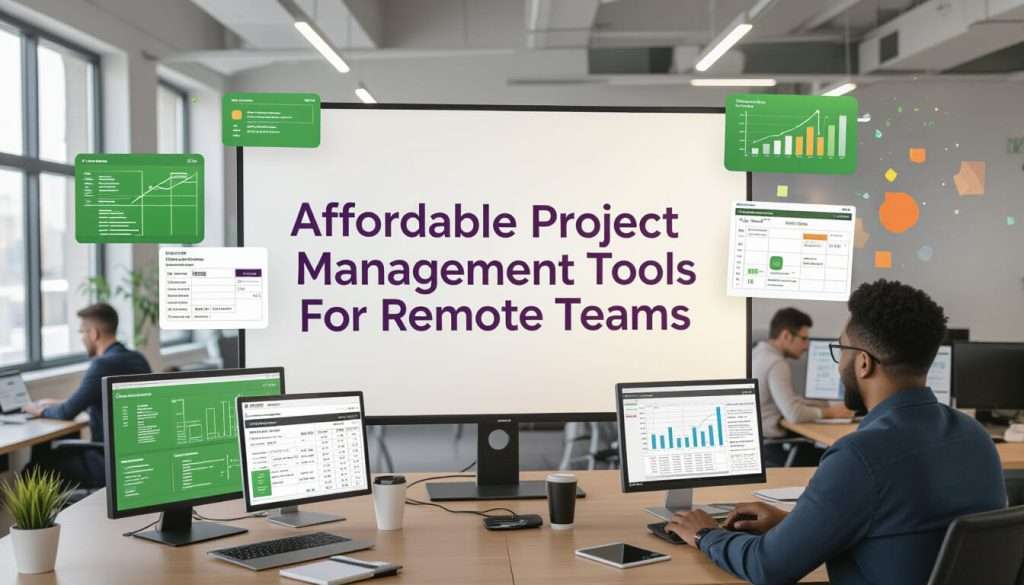
Affordable Project Management Tools For Remote Teams
In practical terms, affordable project management tools for remote teams give geographically distributed members clear ways to track tasks, communicate, and manage projects without stretching the budget.
Key Takeaways On Affordable Project Management Tools For Remote Teams
- Trello offers the most budget-friendly option for small teams with visual project needs at under $10 per user, while Asana provides more robust workflow automation for growing teams.
- Remote teams should prioritize tools with strong communication features, file sharing, and time zone management to overcome the common challenges of distributed work.
- Free plans from tools like ClickUp and Notion can provide surprising value for startups and small businesses without immediate budget for premium software.
- The best affordable project management tool depends on team size – with Trello and Todoist ideal for teams under 10, and ClickUp or Monday.com offering better value for midsize organizations.
- Upskillist provides comprehensive project management training that can help teams maximize their efficiency with any tool they choose.
Remote work is here to stay, with 12.7% of full-time employees working from home and another 28.2% operating on hybrid schedules according to recent studies. This shift demands specialized tools that facilitate smooth collaboration across time zones and physical locations. Finding the perfect balance between functionality and affordability is crucial.
Why Remote Teams Need Specialized Project Management Tools
Remote work introduces unique challenges that traditional office environments simply don’t face. Without the right digital infrastructure, distributed teams quickly encounter communication gaps, missed deadlines, and workflow bottlenecks. Specialized project management tools create a virtual workspace where team members can collaborate seamlessly regardless of location.
These tools replace the physical office’s natural collaboration environment with digital alternatives. The whiteboard in the conference room becomes a shared task board. The quick desk-side conversation transforms into instant messaging. The team status meeting evolves into automated progress tracking. Without these digital counterparts, remote teams struggle to maintain productivity and alignment.
Remote Work Challenges That The Right Tool Solves
Working remotely introduces several obstacles that can derail productivity if not properly addressed. Time zone differences make synchronous communication difficult, leading to delays and miscommunications. Without physical presence, tracking project progress becomes challenging as managers can’t simply walk the floor to check status. File sharing and version control become complex when team members can’t exchange physical documents or point to the same screen.
The right project management tool addresses these challenges by creating a single source of truth accessible to all team members at any time. It eliminates the “out of sight, out of mind” problem by making work visible and accountable. This visibility ensures nothing falls through the cracks while providing managers with real-time insights into project progress and potential bottlenecks.
Essential Features For Distributed Team Collaboration
When evaluating affordable project management tools for remote teams, certain features prove essential for effective collaboration. Task assignment and tracking functionality forms the backbone of any system, allowing clear ownership and deadline management. Communication tools, including comments, mentions, and chat integrations, keep conversations contextual and accessible. File sharing capabilities eliminate the need for separate document management systems, while calendar integration ensures everyone stays synchronized despite different time zones.
Look for tools that provide customizable notifications to prevent information overload while keeping team members informed of relevant updates. Mobile accessibility is increasingly important as remote workers often need to check progress or make quick updates while away from their desks. Finally, reporting features help managers track productivity and identify improvement opportunities without micromanaging.
Pro Tip: Before committing to any project management solution, identify your team’s three most critical workflow challenges and ensure your chosen tool directly addresses them. Features are only valuable if they solve your specific problems.
1. Trello: Simple Kanban-Style Management Under $10/User
Trello remains one of the most accessible entry points for teams seeking visual project management without a significant financial commitment. Its intuitive drag-and-drop interface mimics physical kanban boards, making it instantly understandable for new users. At just $5 per user monthly (billed annually) for its Standard plan, Trello offers exceptional value for budget-conscious teams.
The visual card-based system excels at providing immediate project visibility. Each card represents a task that can be moved through customizable workflow stages, mimicking how work naturally progresses. This visualization helps remote teams maintain awareness of project status without requiring constant status meetings or check-ins.
Free Plan Features For Small Teams
Trello’s free plan offers surprising utility for small teams or those just beginning to formalize their project management approach. It includes unlimited cards and up to 10 boards per workspace, providing ample space for multiple projects. The plan supports unlimited storage (with a 10MB per file attachment limit), basic automation capabilities with Butler, and unlimited activity logs to track historical changes.
Paid Features Worth The Investment
For growing teams, Trello’s paid plans introduce capabilities that justify the modest investment. The Standard plan ($5/user/month billed annually) adds unlimited boards, advanced checklists, custom fields for better data organization, and expanded automation capabilities. These features dramatically enhance workflow efficiency and data management without complicated setup processes.
Best For Visual Project Tracking
Trello shines brightest for teams whose projects benefit from visual management approaches. Design teams tracking creative projects, content teams managing editorial calendars, and engineering teams using agile methodologies all find Trello’s visual approach particularly effective. The ability to add custom backgrounds, labels, and cover images makes it easy to visually distinguish between different projects or priority levels at a glance.
2. Asana: Workflow Automation On A Budget
When remote teams need more structured workflow management with robust automation capabilities, Asana delivers exceptional value at a reasonable price point. Starting at $10.99 per user monthly for its Premium plan, Asana provides sophisticated project management features that grow with your team’s complexity. Its strength lies in reducing manual work through intelligent workflow automation while maintaining an intuitive user experience.
Free Vs. Premium Plan Comparison
Asana’s free plan accommodates teams of up to 15 members with impressive functionality. It includes unlimited tasks, projects, messages, and activity logs, providing a comprehensive foundation for project management. The free tier also offers basic board, list, and calendar views, assignee and due date capabilities, and integration with time tracking tools like Harvest.
| Feature | Free Plan | Premium Plan ($10.99/user/month) |
|---|---|---|
| Team members | Up to 15 | Unlimited |
| Project views | List, Board, Calendar | List, Board, Calendar, Timeline, Gantt |
| Workflow rules | None | Up to 50 per project |
| Custom fields | Limited | Unlimited |
| Reporting | Basic | Advanced dashboards |
Timeline And Dependencies Features
Asana’s timeline view transforms complex projects into visual roadmaps that remote teams can easily comprehend. This Gantt-chart style interface allows managers to map dependencies between tasks, identify potential bottlenecks, and adjust schedules with simple drag-and-drop actions. For remote teams juggling multiple deadlines, this visualization helps prevent scheduling conflicts and ensures resources are allocated efficiently across projects.
Dependencies management is particularly valuable for remote teams where sequential work needs careful coordination. Team members can see exactly what tasks must be completed before they can begin their assignments, eliminating confusion and preventing premature starts that lead to rework. This feature alone can justify Asana’s premium cost for teams working on complex, multi-stage projects with tight interdependencies.
Integration Capabilities For Remote Teams
Asana’s extensive integration ecosystem enhances its value proposition for remote teams using multiple digital tools. With over 200 native integrations including Slack, Microsoft Teams, Google Workspace, and Zoom, Asana becomes the central hub that connects your entire digital workspace. These integrations reduce context switching and keep all project-related information accessible from a single platform.
For development teams, the GitHub and Bitbucket integrations allow automatic task updates when code is committed. Marketing teams benefit from connections to Mailchimp and HubSpot. The versatile Zapier integration extends Asana’s reach to over 3,000 additional applications, making it adaptable to virtually any remote team’s technology stack without requiring expensive custom development.
3. ClickUp: All-In-One Platform With Competitive Pricing
ClickUp has rapidly gained popularity as an affordable all-in-one solution that combines project management, documents, goals, chat, and more in a single platform. Its Unlimited plan starts at just $5 per member per month, offering exceptional value for teams seeking comprehensive functionality without separate subscriptions for multiple tools.
What distinguishes ClickUp is its remarkable flexibility in adapting to different work styles within the same organization. Marketing teams can use Kanban boards while development teams leverage sprint planning features, all within the same workspace. This versatility makes ClickUp particularly well-suited for cross-functional remote teams with diverse workflow requirements.
Task Management And Document Collaboration
ClickUp’s task management capabilities go beyond basic assignment and tracking to include multiple ways of organizing and visualizing work. Teams can switch between over 15 different views including list, board, calendar, Gantt, workload, and mind map perspectives. This flexibility allows team members to interact with project data in whatever format best suits their role and working style.
Time Tracking And Reporting Tools
For remote teams where time tracking is essential, ClickUp includes native time tracking at all plan levels, even the free tier. Team members can track time directly within tasks, generate timesheets, and analyze time usage across projects. This integrated approach eliminates the need for separate time tracking subscriptions, delivering significant cost savings for budget-conscious organizations.
The reporting capabilities provide managers with actionable insights into team productivity and project progress. Customizable dashboards visualize key metrics like task completion rates, time estimates versus actuals, and resource allocation. These analytics help remote team leaders identify bottlenecks, balance workloads, and make data-driven decisions without requiring expensive business intelligence tools.
Customization Options For Different Team Needs
ClickUp’s extreme customizability is particularly valuable for remote teams with specific workflow requirements. Custom fields, statuses, and relationships can be configured to match exactly how your team works rather than forcing you to adapt to the software’s limitations. This flexibility extends to automations, where teams can create custom rules to handle repetitive tasks without coding knowledge.
4. Monday.com: Visual Team Management With Scalable Pricing
Monday.com stands out with its colorful, highly visual interface that makes project data engaging and instantly comprehensible. Starting at $8 per user per month for its Basic plan, it offers a visually-oriented approach to project management that many remote teams find more intuitive than text-heavy alternatives. The platform excels at transforming complex workflows into visual systems that teams can easily navigate regardless of technical background.
The platform’s “building block” approach allows teams to construct custom workflows without technical expertise. This accessibility makes Monday.com particularly valuable for remote teams with varying levels of technical sophistication or for organizations transitioning from manual project management methods to digital solutions for the first time.
Entry-Level Plan Features
Monday.com’s Basic plan includes unlimited boards and over 20 column types for organizing information exactly as needed. While more limited than higher tiers, it provides sufficient functionality for smaller remote teams to create visual workflows, assign responsibilities, and track basic project progress. The plan supports unlimited free viewers, allowing external stakeholders to see project data without consuming paid licenses.
“We evaluated seven different project management platforms before choosing Monday.com. The visual nature made it immediately accessible to our non-technical team members, while the customization options satisfied our developers’ specific needs. It’s rare to find a solution that works equally well for both audiences.” – Sarah Chen, Operations Director at a remote-first marketing agency
Dashboard And Reporting Capabilities
For remote team leaders, the ability to quickly gauge project health without scheduling status meetings saves considerable time and reduces interruptions to team workflow. Dashboards can be shared with executives or clients to provide transparent progress updates without granting access to detailed task data. This flexibility in information sharing proves especially valuable when collaborating with external stakeholders who need insights without full system access.
5. Notion: Flexible Workspace With Project Management Features
Notion has revolutionized the affordable project management landscape by blending document management, wikis, databases, and project tracking into a uniquely flexible workspace. At just $8 per user monthly for its Team plan, Notion offers tremendous value for remote organizations seeking to consolidate multiple tools into a single platform. Its blank-canvas approach provides unmatched freedom to create customized systems tailored to your specific workflow needs.
Unlike traditional project management tools with rigid structures, Notion allows teams to build exactly what they need. This flexibility makes it particularly appealing for creative teams, startups, and organizations with unique processes that don’t fit neatly into conventional project management frameworks. The platform effectively eliminates the frustration of forcing your workflow to match your software’s limitations.
Document And Knowledge Base Integration
Notion’s greatest strength for remote teams is the seamless integration between project management and documentation. Traditional teams can walk to a colleague’s desk for context or check a physical file cabinet for background information. Remote teams need this context digitally accessible, and Notion excels by connecting tasks directly to comprehensive documentation, meeting notes, and process guidelines.
Project Tracking Templates
Notion’s template gallery provides dozens of pre-built project tracking systems that remote teams can implement instantly or customize to their specific requirements. The template ecosystem extends beyond official Notion templates to include thousands of community-created options shared by users worldwide. This extensive library means most teams can find a starting point that closely matches their needs, then make minor adjustments rather than building systems from the ground up. This approach dramatically reduces implementation time compared to more rigid project management platforms.
Team Collaboration Tools
Notion’s commenting, mentioning, and real-time editing features create a collaborative environment where remote team members can work together as effectively as if they were in the same room. Comments can be attached to specific paragraphs, database entries, or even individual cells, keeping discussions contextual and organized. The @mention system ensures relevant team members are notified when their input is needed without overwhelming everyone with notifications.
6. Basecamp: Fixed-Price Solution For Unlimited Users
Basecamp stands apart in the project management landscape with its refreshingly straightforward pricing model: $99 per month flat rate for unlimited users and projects. This predictable cost structure eliminates the scaling anxiety that often accompanies per-user pricing models, making Basecamp exceptionally budget-friendly for growing remote teams. Organizations can add new team members without recalculating budgets or seeking additional approvals, removing a significant friction point in team expansion.
The platform’s philosophy emphasizes focused simplicity over feature abundance. Rather than competing in the feature arms race, Basecamp provides a carefully curated set of tools organized around how teams naturally work together. This approach reduces the overwhelming complexity that often plagues more feature-rich alternatives, making it particularly suitable for remote teams with varying technical abilities.
Communication And File Sharing Tools
Basecamp’s communication tools center around keeping conversations organized and contextual. Message boards replace scattered email threads, providing topical discussions that remain accessible to current and future team members. File sharing in Basecamp follows the same principle of organized simplicity. Files attach directly to projects, discussions, or tasks where they’re relevant, eliminating the “where did I put that file?” problem common in remote work. The platform maintains version history and allows for commenting directly on files, keeping feedback and iterations organized alongside the assets themselves. This integrated approach reduces the chaos of managing multiple storage locations or tracking feedback across different communication channels.
Project Scheduling Features
Basecamp approaches scheduling through its straightforward calendar and to-do list system. For many remote teams, this simplified scheduling approach proves sufficient while avoiding the complexity that often leads to abandoned or poorly maintained project plans in more sophisticated systems. The focus on practical usability over theoretical completeness makes Basecamp particularly effective for teams that value reliable execution over elaborate planning capabilities.
7. Zoho Projects: Feature-Rich Platform For Small Budgets
Zoho Projects delivers enterprise-grade project management capabilities at startlingly affordable rates, starting at just $4 per user monthly for its Premium plan. As part of the broader Zoho ecosystem, it offers exceptional integration with business tools like CRM, accounting, and email while maintaining competitive standalone value. This combination of affordability and integration makes it particularly appealing for remote businesses seeking comprehensive digital infrastructure without enterprise-level budgets.
The platform’s strength lies in delivering professional project management features that typically command much higher price points from competitors. For remote teams transitioning from spreadsheet-based management or entry-level tools, Zoho Projects provides a significant capability upgrade without the corresponding price increase normally associated with such advancements.
Issue Tracking And Time Management
Zoho Projects excels at issue tracking for remote teams who need to manage bugs, customer requests, or internal improvement initiatives. The system allows detailed categorization, priority setting, and status tracking with customizable workflows that adapt to how your team resolves different types of issues. Time management features include built-in timesheets, time estimation, and tracking against those estimates. For remote teams billing by the hour or needing to justify time allocation, these features provide valuable accountability without requiring separate time tracking software. The system also generates comprehensive time reports that help managers understand where team capacity is being spent and identify opportunities for efficiency improvements.
Document Management System
Zoho Projects includes a robust document management system that supports version control, approval workflows, and check-in/check-out procedures to prevent conflicting edits. For remote teams collaborating on documents, these controls prevent the confusion of multiple versions circulating simultaneously or changes being accidentally overwritten. This contextual organization significantly reduces the time remote workers spend searching for information, allowing them to quickly locate relevant documents based on their project context rather than remembering specific file names or storage locations.
8. nTask: Budget Option With Premium Features
nTask has emerged as a compelling option for budget-conscious remote teams seeking comprehensive project management capabilities without premium pricing. At just $3 per user monthly for its Premium plan, it offers one of the most attractive price points in the market while delivering functionality that competes with much more expensive alternatives. Despite its affordable pricing, nTask avoids cutting corners on essential features. The platform includes project and task management, team collaboration tools, time tracking, issue management, and risk assessment capabilities typically found in solutions costing three to four times as much.
Task Management And Gantt Charts
nTask’s task management system goes beyond basic to-do lists to include subtasks, recurring tasks, dependencies, and customizable statuses. These features allow remote teams to create structured workflows that accurately reflect their actual processes rather than forcing adaptation to the software’s limitations. The platform’s Gantt chart functionality provides visual project mapping with drag-and-drop simplicity for adjusting timelines and dependencies. For remote teams coordinating complex projects with sequential tasks, these visualizations help identify potential bottlenecks or scheduling conflicts before they impact deadlines. The Gantt view also facilitates resource planning by providing clear visibility into which team members may be overallocated across multiple projects.
Meeting Management Tools
nTask distinguishes itself with dedicated meeting management features rarely found in affordable project management platforms. The system allows teams to schedule meetings, create agendas, assign action items, and maintain minutes all within the same environment where project work is managed. For distributed teams across multiple time zones, the meeting scheduler automatically suggests appropriate times based on participant availability and location. This feature alone saves considerable time compared to the back-and-forth emails typically required to coordinate meetings across global teams.
9. Freedcamp: Forever-Free Core Features
Freedcamp offers one of the most generous free tiers in the project management space, providing core functionality without user or project limits. This approach makes it an exceptional starting point for remote teams with minimal budget who need fundamental project organization capabilities. While the free plan lacks some advanced features, it provides significantly more capability than most competitors’ free offerings. Teams gain access to task management, discussions, file storage, calendars, and even basic time tracking without spending a dollar. This comprehensive free tier makes Freedcamp particularly valuable for nonprofit organizations, volunteer groups, and early-stage startups operating with minimal resources.
Task Management And Discussion Boards
Freedcamp’s task management system supports multiple view options including list, kanban board, and calendar perspectives. This flexibility allows different team members to interact with tasks in whatever format best suits their role and working style. Discussion boards provide structured conversations organized by topic rather than scattered across emails or chat tools. This approach creates searchable knowledge repositories that remain accessible as team composition changes over time. For remote teams that experience turnover or bring in temporary contributors, these persistent discussions preserve valuable context that would otherwise be lost when individuals depart.
Paid Add-Ons For Advanced Needs
Freedcamp’s modular pricing approach allows teams to pay only for the advanced features they actually need rather than forcing upgrades to comprehensive premium tiers. Add-ons like CRM, invoicing, wiki, and issue tracker can be purchased individually starting at $1.99 per user monthly. This a la carte model enables precise tailoring of capabilities to requirements without paying for unused features. For growing remote teams, this incremental approach to upgrading provides significant cost control compared to all-or-nothing premium tiers. Organizations can strategically invest in specific capabilities that deliver immediate value while deferring other expenditures until they become business-critical. The result is a project management solution that scales economically alongside team development rather than forcing premature investment in enterprise capabilities.
10. Todoist: Streamlined Task Management For Small Teams
Todoist brings sophisticated task management to remote teams at just $4 per user monthly for its Business plan. Unlike comprehensive project management platforms, Todoist focuses exclusively on task management but executes this core function with exceptional elegance and efficiency. The platform’s strength lies in its remarkable ease of use combined with surprising depth of functionality. Natural language input allows team members to create tasks by typing phrases like “Submit expense report by Friday at 5pm #finance @sarah,” which Todoist automatically parses into due dates, projects, and assignments. This intuitive interaction significantly reduces the friction associated with maintaining task systems and encourages consistent use across remote teams.
Simple Interface For Quick Implementation
Todoist’s clean, minimalist interface eliminates the steep learning curve associated with more complex project management tools for remote teams. New team members can become productive within minutes rather than requiring extensive training sessions. Despite its simplicity, the platform supports sophisticated task organization including projects, sections, subtasks, priorities, labels, and filters. This combination of approachability and capability makes Todoist especially effective for remote teams with varying technical confidence levels. Team members who might resist complex project management platforms readily adopt Todoist’s straightforward approach, improving overall participation in task tracking.
Cross-Platform Availability
Todoist provides one of the most comprehensive cross-platform experiences in the task management space, with native applications for Windows, macOS, iOS, Android, web browsers, and even wearables. This ubiquitous availability ensures remote team members can access their tasks regardless of device or location – a critical consideration for distributed workforces using varied technology setups.
Comparing Cost-to-Value Ratio: Which Tool Gives The Best ROI?
When evaluating affordable project management tools for remote teams, pure subscription cost tells only part of the story. The true measure of value comes from dividing functionality by price to determine which solution delivers the most capability per dollar spent. This cost-to-value analysis reveals some surprising insights that contradict conventional wisdom about “premium” platforms versus budget alternatives.
Price Per User Analysis
Looking strictly at monthly per-user costs reveals significant variation across platforms. Trello and ClickUp lead with $5 per user monthly rates for their standard plans, while Asana and Monday.com command approximately twice that amount. Basecamp’s flat $99 monthly rate becomes increasingly economical as team size grows – breaking even with per-user platforms around the 10-15 user mark and delivering exceptional value for larger teams.
Feature Set Comparison Chart
When mapping features against pricing tiers, clear value leaders emerge for different team types. For teams requiring comprehensive documentation alongside project management, Notion delivers exceptional value by eliminating the need for separate knowledge base subscriptions. Teams heavily focused on time tracking find nTask’s included time management features eliminate the need for dedicated time tracking software, effectively reducing total technology costs.
Hidden Costs To Watch For
Beyond subscription fees, savvy remote teams must consider several hidden costs that affect total investment. Storage limitations can force upgrades to higher tiers when file sharing becomes extensive. Integration capabilities determine whether existing tools continue functioning with new project management platforms or require replacement. Admin time spent configuring and maintaining complex systems represents a significant hidden cost rarely factored into budget calculations.
The learning curve associated with implementation directly impacts team productivity during transition periods. Intuitive platforms like Trello or Todoist minimize this productivity dip, while more complex systems like Monday.com or ClickUp may require dedicated training time. This temporary efficiency reduction should be calculated as part of the total cost of ownership when comparing affordable options.
Implement These Tools For Maximum Team Efficiency
Selecting the right affordable project management tool represents only half the battle for remote teams. Effective implementation determines whether your investment delivers transformative productivity improvements or becomes another underutilized digital tool. The most successful implementations focus equally on technical setup and human adoption factors, recognizing that even perfect software fails without consistent user engagement.
Onboarding Best Practices
Begin implementation with a pilot group of enthusiastic early adopters rather than forcing immediate company-wide adoption. This approach allows workflow kinks to be identified and resolved before scaling to less technically confident team members. Document specific use cases relevant to your organization rather than relying on generic platform tutorials, helping team members understand how the tool applies to their actual work.
Create standardized project templates that reflect your organization’s recurring workflows before full rollout begins. These templates dramatically reduce the “blank page anxiety” that often prevents consistent adoption while ensuring standardized approaches across different team members. For remote teams, this standardization creates much-needed consistency that compensates for the lack of physical workspace cues.
Team Training Tips
Resist the temptation to showcase every feature during initial training sessions. Focus instead on the 20% of functionality that delivers 80% of value for daily work, allowing team members to build confidence with core features before exploring advanced capabilities. Record short, task-specific video tutorials that remote team members can reference on-demand rather than requiring synchronized training sessions across different time zones.
Integration With Your Current Tech Stack
Prioritize integrations with your most heavily used existing tools to create workflow continuity rather than digital fragmentation. Email integrations typically deliver the highest immediate value by connecting project management to where most team members already spend significant time. Calendar synchronization ranks second for importance, ensuring project deadlines automatically appear in personal scheduling tools rather than requiring manual duplication.
Free Trials And Test Drives: Try Before You Buy
Every affordable project management platform discussed offers free trial periods ranging from 7 to 30 days. These evaluation periods provide critical opportunities to assess real-world fit before financial commitment. Rather than casually exploring during trials, create a structured evaluation process that methodically tests how each platform handles your team’s specific workflows and collaboration requirements.
Evaluation Criteria Checklist
Develop a weighted scorecard that prioritizes your non-negotiable requirements versus merely desirable features. Include technical criteria like integration capabilities alongside human factors such as interface intuitiveness and mobile usability. Pay particular attention to reporting functionality, as this often becomes a significant limitation in budget-friendly options that otherwise meet basic task management needs.
Questions To Ask During The Trial Period
Challenge each platform with specific scenarios your team regularly encounters rather than generic project management use cases. How does it handle unexpected priority shifts? Can approvals be delegated during team member absences? Does it maintain performance with your actual volume of tasks and projects? These practical questions reveal real-world suitability better than feature checklists.
Solicit feedback from team members representing different roles, technical comfort levels, and working styles. The most successful project management implementations achieve broad adoption across diverse user types rather than serving only the most technically sophisticated team members. Pay particular attention to feedback from team members who express initial skepticism, as their perspectives often highlight genuine usability concerns.
FAQ’s About Affordable Project Management Tools For Remote Teams
The following questions address the most common concerns remote teams raise when selecting affordable project management tools for remote teams. These practical insights come from helping hundreds of organizations implement effective digital collaboration systems within budget constraints.
What’s the most affordable project management tool for a team of 5-10 people?
For small remote teams of 5-10 members, Trello offers exceptional value at just $5 per user monthly for its Standard plan. With intuitive visual task management, basic automation capabilities, and unlimited storage, it provides all essential functionality without unnecessary complexity. The platform’s minimal learning curve ensures rapid adoption even among less technical team members, maximizing return on investment.
Teams requiring more structured project management might consider nTask at $3 per user monthly for its Premium plan. Despite its budget-friendly price, it includes Gantt charts, time tracking, and meeting management features typically found in much more expensive alternatives. This comprehensive functionality makes it particularly suitable for small teams managing complex projects with sequential dependencies and strict deadlines.
Can free project management tools handle complex projects effectively?
Free project management tools for remote teams can adequately handle moderately complex projects with certain limitations. Trello’s free tier supports unlimited cards across 10 boards with basic automation, sufficient for managing multiple concurrent projects with straightforward workflows. Asana’s free plan accommodates up to 15 team members with unlimited tasks and projects, though it lacks timeline views and reporting capabilities essential for complex dependency management.
“We managed a 50-person website redesign entirely on ClickUp’s free plan for six months before upgrading. The limitations were real – particularly around advanced reporting and views – but we developed workarounds that kept the project on track without spending a dollar on software. For cash-constrained startups, creative use of free tiers can deliver 80% of the value at zero cost.” – Marcus Johnson, Startup Advisor
The primary limitations of free tiers appear in visualization options, automation capabilities, and reporting functionality. Teams can overcome these constraints through manual workarounds like regular status meetings and spreadsheet-based reporting, though these approaches consume time that premium features would save. As project complexity increases, the productivity gains from paid features typically outweigh subscription costs through increased efficiency.
How do I migrate existing project data to a new management tool?
Most affordable project management platforms offer CSV import functionality that facilitates migration from spreadsheets or other basic tracking systems. For transitions between project management tools, specialized migration services like Unito or Pleexy provide automated transfer capabilities for around $10-20 per user – a worthwhile investment to preserve historical data and ensure continuity during platform changes.
Which project management tools offer the best mobile experience for remote teams?
Trello and Todoist consistently receive the highest ratings for mobile usability across both iOS and Android platforms. Their applications provide nearly full functionality rather than the limited mobile capabilities typical of more complex platforms. This comprehensive mobile support proves especially valuable for field-based team members who primarily access projects through smartphones rather than computers.
When evaluating mobile capabilities, look beyond basic task viewing to assess whether team members can perform their most frequent actions without switching to desktop interfaces. The most effective mobile experiences include quick task creation, comment responses, file attachments, and status updates rather than merely read-only access. These capabilities ensure continuous project momentum regardless of team member location or device access.
Consider implementing mobile-specific training for your selected platform, as many teams underutilize mobile capabilities due to unfamiliarity rather than actual limitations. Short video tutorials demonstrating efficient mobile workflows can significantly increase adoption among team members who frequently work away from traditional computer setups.
Is it better to pay monthly or annually for project management software?
Annual payment plans typically offer discounts between 10-20% compared to monthly billing, making them economically advantageous for established remote teams with stable workflows. However, this financial benefit comes with reduced flexibility to change platforms if your initial selection proves unsuitable. For teams implementing project management software for the first time, the monthly premium may be worthwhile during the initial 3-6 months to maintain switching flexibility.
A hybrid approach often delivers optimal results: begin with monthly billing during your evaluation period, then transition to annual payments once you’ve confirmed the platform meets your requirements. Most vendors allow mid-term conversion to annual billing with prorated discounts, allowing you to capture savings once confidence in the platform is established. This approach balances the risk mitigation of monthly flexibility with the cost advantages of annual commitment.
Whether you lead teams remotely, locally, or fly solo, your projects deserve a professional yet highly affordable foundation. The Project Management Toolkit Bundle delivers exactly that for $147, with no recurring fees. Launch pricing and bonuses can expire soon and without notice.
===========================================================================
ABOUT THE AUTHOR
Gerard Mohamed is a project management expert with over 30 years of hands-on experience managing high-stakes projects in the petrochemical and marine engineering sectors. As a volunteer within many non-profits, he has successfully implemented systems to increase the operational efficiencies of these organizations.
He holds an MBA from Business School Netherlands and a BCom (Hons) with dual majors in Project Management and Advanced Marketing. As a qualified Marine Engineer, Gerard serves as Chairman of the Cape Branch of the South African Institute of Marine Engineers and Naval Architects (SAIMENA) and sits on their National Executive Committee.
Gerard is a fully accredited Facilitator and Assessor for Project Management under South Africa’s SETA and QCTO, and teaches Project Management part-time at two leading business colleges.
After decades of struggling to find practical, field-tested project templates, he created BestProjectKits.com — a comprehensive library of 3,500+ professionally designed templates that solve real-world project challenges across 20+ industries.
→ Explore the complete template library at BestProjectKits.com
→ Connect with Gerard: [admin@bestprojectkits.com]
=========================================================================