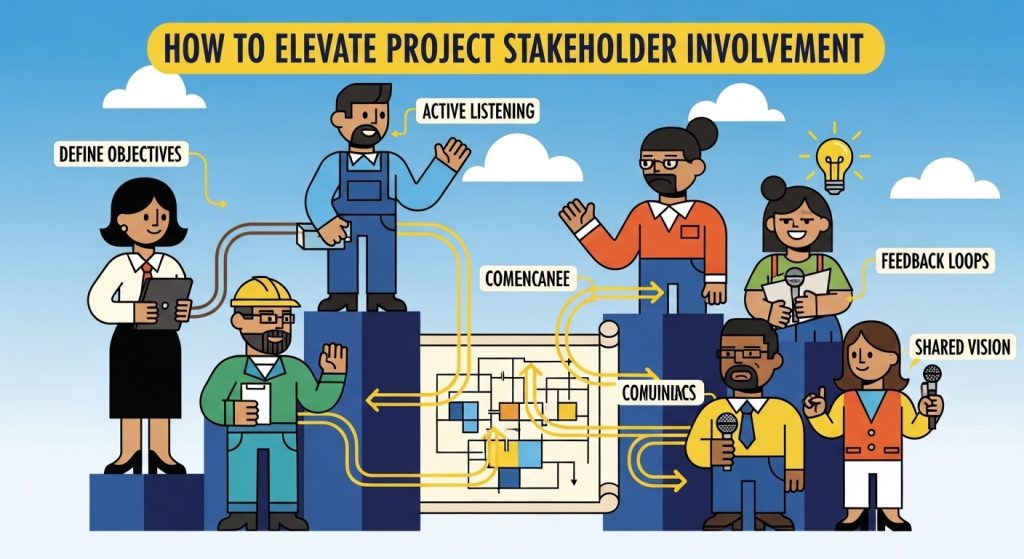
How To Elevate Project Stakeholder Involvement
It is indeed possible to elevate project stakeholder involvement by fostering trust through transparent, two-way communication and actively incorporating their feedback to build ownership. Essential strategies include identifying stakeholders early, tailoring engagement to their interests, holding interactive workshops, using real-time dashboards, and recognizing their contributions to project success.
Key Takeaways: Elevate Project Stakeholder Involvement
- Effective project stakeholder engagement is critical to project success, with early involvement reducing the risk of project failure by up to 40%
- The Stakeholder Engagement Transformation Framework provides a structured approach to identifying, understanding, and involving key players throughout the project lifecycle
- Tailored communication strategies that match stakeholder preferences increase engagement rates and project buy-in
- Creating meaningful involvement opportunities transforms passive stakeholders into active project champions
- Regular measurement of engagement levels allows for timely adjustments and continuous improvement of stakeholder relationships
Most projects don’t fail because of technical problems — they fail because of people problems. The success of your project hinges on effective stakeholder involvement more than almost any other factor. BrightWork’s research shows that projects with high stakeholder engagement are 2.5 times more likely to succeed than those with minimal involvement, yet many organizations still treat stakeholder management as an afterthought. Understanding who your stakeholders are and how to effectively engage them is crucial for project success.
Why Most Projects Fail: The Stakeholder Involvement Gap
Despite advances in project management methodologies, the failure rate of projects remains stubbornly high. According to recent research, 70% of projects fail to deliver their intended outcomes, and inadequate stakeholder engagement is cited as a primary cause in over half of these cases. The stakeholder involvement gap exists when there’s a disconnect between those implementing a project and those affected by or influencing its outcome.
This gap typically manifests in three ways: insufficient identification of key stakeholders, poor understanding of stakeholder needs and expectations, and inadequate communication throughout the project lifecycle. Projects often focus heavily on technical deliverables while underinvesting in the human element that ultimately determines success. When stakeholders feel sidelined or that their concerns aren’t being addressed, they naturally withdraw support or actively resist change.
4 Critical Consequences of Poor Stakeholder Engagement
The ripple effects of inadequate stakeholder involvement extend far beyond immediate project outcomes. Understanding these consequences provides powerful motivation to prioritize stakeholder engagement as a core project management discipline rather than a peripheral activity.
Project Delays and Budget Overruns
When stakeholders aren’t properly engaged, late-stage feedback often leads to significant rework. These unexpected changes cascade through the project timeline, causing delays that impact dependent activities and stretch resources. Research shows that projects with poor stakeholder engagement experience 35-50% more timeline extensions than those with robust engagement strategies.
Budget impacts follow closely behind schedule delays. The cost of incorporating major changes increases exponentially as a project progresses, with late-stage modifications costing up to 100 times more than if identified during planning. These financial consequences don’t just affect the current project—they can undermine future initiatives by eroding organizational trust in project management processes.
Misalignment With Business Objectives
Projects that fail to continuously engage with key decision-makers risk delivering outcomes that no longer align with organizational priorities. Business environments change rapidly, and without regular stakeholder input, project teams may optimize for outdated objectives. This misalignment becomes particularly dangerous in long-term projects where market conditions, competitive landscapes, or regulatory requirements may shift significantly.
Change Resistance
- Psychological ownership is missing when stakeholders aren’t involved in shaping solutions
- Implementation becomes unnecessarily difficult as users haven’t had input into design decisions
- Organizational change management efforts must work twice as hard to overcome initial resistance
- The “not invented here” syndrome emerges when solutions feel imposed rather than co-created
Change resistance directly impacts adoption rates and ultimately the realization of expected benefits. When stakeholders feel ownership over a solution—because they’ve contributed meaningfully to its development—they become champions rather than critics. This transition from resistance to advocacy is perhaps the most valuable outcome of effective stakeholder engagement.
Damaged Relationships and Trust
Perhaps the most lasting consequence of poor stakeholder engagement is the erosion of trust between project teams and their stakeholders. When expectations are mismanaged or stakeholders feel their input has been ignored, the resulting disappointment extends beyond the current project. This trust deficit makes future initiatives more difficult to launch and sustain, creating a negative cycle that becomes increasingly challenging to break. For more insights, check out these ways to engage stakeholders.
The Stakeholder Engagement Transformation Framework
Elevating stakeholder involvement isn’t about adding more meetings to already busy calendars. It requires a structured approach that begins early and evolves throughout the project lifecycle. The Stakeholder Engagement Transformation Framework provides a comprehensive methodology for building meaningful involvement at every stage.
This five-step approach transforms traditional stakeholder management into a strategic advantage. By systematically identifying, understanding, engaging, involving, and measuring stakeholder interactions, you create a foundation for project success that extends far beyond technical deliverables. Each step builds upon the previous one, creating a virtuous cycle of increasing engagement and commitment. For more insights, consider exploring ways to improve project stakeholder engagement.
1. Identify and Map Your Stakeholders
Effective stakeholder mapping goes beyond creating a simple list of names. It requires thoughtful analysis of how each individual or group connects to your project. Start by casting a wide net, considering anyone who might influence, be affected by, or have an interest in your project’s outcomes. This includes obvious stakeholders like sponsors and end users, but also extends to those with indirect connections such as regulatory bodies, support teams, and even competitors.
1. Identify and Map Your Stakeholders
Effective stakeholder mapping goes beyond creating a simple list of names. It requires thoughtful analysis of how each individual or group connects to your project. Start by casting a wide net, considering anyone who might influence, be affected by, or have an interest in your project’s outcomes. This includes obvious stakeholders like sponsors and end users, but also extends to those with indirect connections such as regulatory bodies, support teams, and even competitors.
2. Understand Individual Motivations and Concerns
Once you’ve identified who your stakeholders are, the next critical step is understanding what drives them. Each stakeholder has unique priorities, pain points, and perspectives that influence their attitude toward your project. Some are motivated by financial outcomes, others by operational efficiency, and still others by professional development or recognition. Taking the time to understand these individual drivers transforms generic stakeholder management into precision engagement.
Create stakeholder profiles that capture not just roles and contact information, but also communication preferences, decision-making styles, and potential concerns. Personal interviews or targeted surveys can uncover invaluable insights about expectations and potential resistance points. Remember that motivations may be both explicit (formally stated objectives) and implicit (unstated personal or political concerns). The most successful project managers develop the emotional intelligence to recognize and address both types of motivators.
3. Develop Tailored Communication Strategies
One-size-fits-all communication consistently fails to engage stakeholders effectively. Instead, create customized communication plans that align with each stakeholder’s preferences and needs. Consider variables such as communication frequency, level of detail, preferred formats, and delivery channels. For example, executive stakeholders may want brief, business-outcome focused updates while technical teams require more detailed operational information.
The most effective communication plans establish clear expectations about what information will be shared, when, and how feedback will be incorporated. This transparency builds trust by demonstrating responsiveness to stakeholder needs while also setting reasonable boundaries. Remember that communication should flow bidirectionally—create multiple channels for stakeholders to provide input, ask questions, and express concerns throughout the project lifecycle.
4. Create Meaningful Involvement Opportunities
Passive information sharing rarely generates true engagement. To elevate stakeholder involvement, create structured opportunities for active participation that go beyond status meetings. Design touchpoints that allow stakeholders to contribute meaningfully to the project in ways aligned with their expertise, influence, and interest levels. These opportunities should be carefully designed to provide genuine value to both the project and the stakeholder.
The timing of involvement is equally important. Early engagement, particularly during requirement definition and solution design, yields the highest return on investment. However, continued involvement throughout implementation and evaluation ensures sustained buy-in. The key is matching the right involvement mechanism to the right stakeholder at the right project phase—a precision approach that maximizes impact while respecting everyone’s time constraints.
5. Measure and Adjust Engagement Levels
What gets measured gets managed, and stakeholder engagement is no exception. Establish specific metrics to track both the quantity and quality of stakeholder interactions. These might include meeting participation rates, feedback response times, implementation of stakeholder suggestions, and satisfaction scores. More sophisticated approaches might measure changes in stakeholder sentiment over time or track how stakeholder input influences key decisions.
Use these measurements to identify engagement gaps and adjust your approach accordingly. If certain stakeholder groups show declining participation, investigate root causes and modify your strategy. Regular engagement reviews, conducted quarterly for longer projects, provide structured opportunities to recalibrate your approach as project conditions and stakeholder needs evolve.
Powerful Tools for Stakeholder Analysis
“Effective stakeholder analysis isn’t about creating documentation—it’s about generating actionable insights that guide your engagement strategy. The right analytical tools transform stakeholder complexity into clear engagement priorities.” – Project Management Institute
Sophisticated stakeholder analysis requires more than intuition—it demands structured frameworks that systematically evaluate relationships and influence patterns. These analytical tools provide objective criteria for prioritizing engagement efforts and allocating limited time and resources. When applied consistently, they reveal patterns and connections that might otherwise remain hidden.
The most effective stakeholder analysis combines multiple frameworks to create a multidimensional view. While each tool offers valuable insights, their real power emerges when used together to cross-validate findings and identify nuanced engagement opportunities. This comprehensive approach helps project teams move beyond simplistic stakeholder categories toward truly strategic involvement.
Remember that stakeholder analysis should be revisited regularly throughout the project lifecycle. Stakeholder positions, influence, and interests evolve as projects progress and organizational conditions change. What begins as a mapping exercise during project initiation should become a living analysis that guides ongoing engagement decisions.
Power-Interest Grid: Prioritizing Your Engagement Efforts
The Power-Interest Grid divides stakeholders into four quadrants based on their level of authority and their concern with project outcomes. This simple but powerful visualization helps you determine appropriate engagement strategies for different stakeholder groups. High-power, high-interest stakeholders require close partnership and frequent communication, while high-power, low-interest stakeholders need sufficient engagement to maintain satisfaction. Low-power, high-interest stakeholders benefit from regular information updates, and low-power, low-interest stakeholders require minimal but consistent monitoring.
Influence-Impact Matrix: Understanding Relationship Dynamics
While similar to the Power-Interest Grid, the Influence-Impact Matrix focuses specifically on stakeholders’ ability to affect change within the project versus how significantly the project affects them. This distinction helps identify stakeholders who may have informal influence despite lacking official authority, such as respected technical experts or well-connected team members. The matrix also highlights stakeholders who will experience major changes as a result of the project, helping you anticipate and address potential resistance points before they escalate into problems.
Digital Collaboration Platforms Worth Implementing
Modern stakeholder engagement increasingly relies on digital tools that facilitate continuous communication and collaboration. Platforms like Microsoft Teams, Slack, and specialized project management solutions create virtual spaces where stakeholders can access information, provide feedback, and participate in ongoing discussions regardless of physical location. The most effective digital environments combine multiple interaction modes—document sharing, discussion forums, visual dashboards, and virtual meeting capabilities—to accommodate different communication preferences and create a comprehensive engagement ecosystem.
When selecting collaboration platforms, prioritize intuitive user experience over feature complexity. The best tool is the one stakeholders will actually use. Consider implementing solutions that integrate with existing systems to minimize learning curves and streamline information flow. Also ensure that security and access controls allow you to manage information sharing appropriately across different stakeholder groups with varying needs for confidentiality.
7 Proven Techniques to Boost Stakeholder Participation
Moving stakeholders from passive awareness to active engagement requires deliberate techniques that create meaningful involvement opportunities. The most successful engagement strategies combine multiple approaches tailored to different stakeholder groups and project phases. These seven techniques have demonstrated consistent effectiveness across diverse project environments and stakeholder populations.
What distinguishes these approaches is their focus on creating genuine value for both the project and the stakeholders involved. Rather than treating engagement as a box-checking exercise, these techniques establish mutually beneficial relationships where stakeholders feel their time and expertise are respected. This reciprocity transforms the dynamic from obligation to collaboration, significantly increasing both the quantity and quality of stakeholder contributions.
1. Early Involvement in Decision-Making
Including stakeholders in key decisions from the earliest project phases dramatically increases their commitment to project success. Create structured opportunities for stakeholders to influence fundamental aspects of the project, such as scope definition, approach selection, and success criteria establishment. This early involvement not only improves decision quality by incorporating diverse perspectives, but also builds psychological ownership that translates into sustained support during implementation challenges. The investment of time upfront pays significant dividends in reduced resistance and increased advocacy throughout the project lifecycle.
2. Regular Project Showcases and Demos
Visibility creates engagement. Schedule regular demonstrations of project progress that transform abstract concepts into tangible outcomes stakeholders can see and experience. These showcases should emphasize actual working capabilities rather than PowerPoint presentations or theoretical descriptions. For technology projects, this might mean demonstrating functional prototypes; for process improvements, it could involve walking through simulations of new workflows.
The most effective showcases include interactive elements that invite stakeholder feedback and suggestions. Create structured opportunities for stakeholders to test deliverables, ask questions, and provide input that genuinely influences ongoing development. This approach not only builds stakeholder confidence in the project direction but also reveals potential issues early when they’re less costly to address.
| Showcase Format | Best For | Engagement Value |
|---|---|---|
| Sprint Reviews/Demos | Software/Digital Projects | High: Shows working functionality |
| Process Walkthroughs | Operational Changes | Medium-High: Visualizes workflow impacts |
| Prototype Testing | Product Development | Very High: Enables hands-on interaction |
| Milestone Celebrations | Long-term Projects | Medium: Builds momentum and visibility |
The timing and frequency of showcases should align with your project methodology and stakeholder availability. Agile projects benefit from brief, frequent demonstrations aligned with sprint cycles, while more traditional approaches might schedule more comprehensive reviews at key milestones. Regardless of cadence, consistency is crucial for building the habit of stakeholder participation.
3. Collaborative Workshops and Planning Sessions
Workshops and planning sessions that actively involve stakeholders in problem-solving create stronger solutions and deeper buy-in. Unlike traditional meetings where information flows primarily one way, collaborative sessions use structured activities designed to capture diverse perspectives and generate collective wisdom. Techniques such as design thinking workshops, journey mapping exercises, and prioritization sessions transform stakeholders from passive listeners into active contributors.
The effectiveness of these sessions depends heavily on thoughtful preparation and skilled facilitation. Define clear objectives, select appropriate activities, and prepare supporting materials that provide necessary context without constraining creativity. During the session, ensure all voices are heard by using techniques that balance participation between dominant and quieter stakeholders. Most importantly, document outcomes and communicate how stakeholder input influenced subsequent decisions.
4. Transparent Project Dashboards
In an information-rich environment, stakeholders appreciate visibility into project performance without having to request updates. Transparent dashboards that display real-time metrics on progress, risks, issues, and key decisions create an environment of trust and shared ownership. These visual tools transform abstract project status into concrete information that stakeholders can easily interpret and discuss. When designed effectively, dashboards highlight both achievements and challenges, encouraging constructive engagement around problem areas rather than hiding them until they become crises. For more insights, explore ways to improve project stakeholder engagement.
The most effective dashboards are tailored to stakeholder interests and decision-making needs. Executive stakeholders may focus on business outcomes and financial metrics, while operational teams need visibility into implementation details and upcoming changes. Consider creating multiple dashboard views or configurable interfaces that allow stakeholders to customize their experience based on their specific interests and responsibilities.
5. Stakeholder Committees and Advisory Groups
Formalized governance structures like steering committees and advisory groups create sustained engagement mechanisms for key stakeholders. These bodies establish clear roles, responsibilities, and decision-making authorities that elevate stakeholder involvement from occasional input to structured oversight. Regular committee meetings provide predictable touchpoints for major decisions and create a forum where stakeholder concerns can be addressed systematically.
The composition of these groups deserves careful consideration. Include representatives from diverse stakeholder communities to ensure comprehensive perspective, but keep membership small enough to enable effective discussion and decision-making. Clearly define the committee’s authority boundaries to avoid confusion about which decisions require broader consultation. Provide members with sufficient information before meetings to enable informed discussion, and follow up diligently on action items to demonstrate that their participation generates tangible results.
6. Recognition and Celebration of Contributions
Acknowledging stakeholder contributions reinforces engagement and builds positive momentum. Create systematic recognition mechanisms that highlight how stakeholder input has influenced the project, from shaping requirements to identifying risks. Simple practices like attributing ideas to specific individuals in project documentation or publicly thanking contributors during presentations can significantly increase motivation for continued involvement. For major contributions, more formal recognition might include feature articles in internal communications, leadership acknowledgment, or awards that highlight exceptional stakeholder partnership.
7. Feedback Loops That Drive Action
The difference between performative engagement and genuine involvement often comes down to how stakeholder feedback is handled. Establish clear processes for collecting, analyzing, and responding to input received through various channels. Create transparency around how feedback is prioritized and incorporated, including honest communication when stakeholder suggestions cannot be implemented. Closing this feedback loop demonstrates respect for stakeholder contributions and builds trust that their time investment in the project yields meaningful influence.
Overcoming Common Stakeholder Engagement Challenges
Even with robust strategies in place, stakeholder engagement inevitably encounters obstacles that can derail progress if not handled effectively. Recognizing these common challenges and having prepared approaches to address them transforms potential roadblocks into opportunities for strengthening relationships. The most successful project leaders anticipate these dynamics and develop contingency plans before issues arise.
- Stakeholder fatigue from multiple concurrent initiatives competing for attention
- Geographic and time zone barriers in distributed project environments
- Cultural differences that affect communication styles and decision processes
- Organizational politics and historical conflicts between stakeholder groups
- Resource constraints limiting stakeholder availability for engagement activities
Addressing these challenges requires both tactical solutions for specific situations and strategic approaches that build engagement resilience over time. Tactical responses might include adjusting meeting times to accommodate global stakeholders or creating condensed update formats for time-constrained executives. Strategic approaches focus on building engagement infrastructure that makes participation easier and more valuable for stakeholders regardless of specific circumstances.
Remember that stakeholder engagement challenges often reflect underlying organizational dynamics rather than project-specific issues. While you may not be able to resolve long-standing conflicts or cultural patterns, acknowledging these realities and designing engagement approaches that work within existing constraints dramatically increases your chances of success. Sometimes the most effective strategy involves working around obstacles rather than attempting to remove them entirely.
Perhaps most importantly, approach engagement challenges with curiosity rather than frustration. When stakeholders resist involvement or express criticism, these reactions often contain valuable information about unaddressed concerns or misaligned expectations. By treating these moments as learning opportunities rather than obstacles, you transform potential project threats into insights that strengthen your approach.
Managing Conflicting Stakeholder Interests
Projects with diverse stakeholders inevitably encounter competing priorities and contradictory requirements. The executive sponsor wants to minimize costs, the compliance team emphasizes regulatory adherence, and end users prioritize ease of use—all legitimate concerns that may pull the project in different directions. Rather than hoping these conflicts will resolve themselves or deferring to the highest-ranking stakeholder, successful project leaders address these tensions directly through structured negotiation and transparent trade-off discussions.
Begin by acknowledging the validity of different perspectives and creating a neutral space where competing interests can be openly discussed. Use visual techniques like prioritization matrices or decision criteria frameworks to make trade-off discussions more objective and less personal. Document the rationale behind compromise decisions to demonstrate that all viewpoints were considered, even when certain priorities ultimately took precedence. This transparency builds trust even among stakeholders whose preferred options weren’t selected.
Engaging Resistant or Disinterested Stakeholders
Some stakeholders actively resist engagement while others simply fail to prioritize project participation among their many responsibilities. For resistant stakeholders, start by understanding the root causes of their opposition—which might include previous negative experiences, perceived threats to their interests, or simple misunderstanding of project benefits. Once you’ve identified specific concerns, tailor your approach to address them directly, whether through modified project scope, additional information sharing, or involvement in decisions affecting their domain. The goal isn’t to eliminate all criticism (which can actually provide valuable perspective) but to transform unproductive resistance into constructive engagement.
Maintaining Momentum Throughout the Project Lifecycle
Stakeholder enthusiasm often peaks during project initiation then gradually declines as implementation challenges emerge and attention shifts to newer initiatives. Countering this natural engagement decay requires deliberate momentum-building strategies at every project phase. Create a cadence of meaningful touchpoints that maintain visibility without creating meeting fatigue. Highlight incremental achievements that demonstrate progress, especially during extended implementation phases where tangible outcomes may be less visible. As the project approaches completion, transition engagement focus toward benefits realization and knowledge transfer, helping stakeholders prepare for successful adoption and sustainable operation.
Your Action Plan: Next Steps to Elevate Project Stakeholder Engagement
Transforming stakeholder engagement doesn’t happen overnight, but meaningful improvement can begin immediately with focused action. Start by assessing your current engagement maturity using the framework provided in this article. Identify the highest-impact gaps in your approach and select 2-3 specific techniques to implement in your next project phase. Document baseline metrics before making changes so you can measure improvement. Consider partnering with your PMO or organizational change management team to align your approach with broader organizational standards. Most importantly, share your successes and challenges with other project leaders to build a community of practice around effective stakeholder engagement that elevates outcomes across your entire organization.
Frequently Asked Questions About How To Elevate Project Stakeholder Involvement
Throughout our work with project teams implementing enhanced stakeholder engagement approaches, certain questions consistently arise. These FAQs address the most common concerns and provide practical guidance for specific stakeholder engagement scenarios you’re likely to encounter in your projects.
How early in the project should I start engaging stakeholders?
Stakeholder engagement should begin at the earliest possible stage—ideally before the project is even formally approved. During concept development and business case creation, engaging key stakeholders helps shape fundamental project parameters and builds ownership that carries through implementation. Research consistently shows that each month of delayed stakeholder involvement increases the probability of requirements changes by approximately 10%, with corresponding impacts on timeline, budget, and overall success likelihood.
For stakeholders who cannot be involved during initiation (perhaps because they haven’t been identified yet), create onboarding processes that efficiently bring them up to speed and provide opportunities to influence remaining decisions. Remember that late-joining stakeholders often need both information about what’s already been decided and clear visibility into where they can still make meaningful contributions.
What’s the difference between stakeholder management and stakeholder engagement?
Stakeholder management and engagement represent fundamentally different mindsets toward project relationships. Management implies a one-directional approach where stakeholders are treated as risks to be mitigated or resources to be allocated. Engagement represents a collaborative partnership where stakeholders actively contribute to shaping and delivering solutions. While management focuses on controlling stakeholder impact, engagement emphasizes creating mutual value through meaningful involvement. The most successful projects evolve from stakeholder management toward increasingly deep engagement as relationships mature and trust develops.
How do I handle stakeholders with conflicting priorities?
Conflicting stakeholder priorities require transparent facilitation rather than behind-the-scenes compromise. Begin by clearly documenting different viewpoints and the legitimate business needs driving each perspective. Create structured decision frameworks that objectively evaluate options against agreed-upon criteria rather than defaulting to the opinions of the most powerful stakeholders. Where true conflicts exist that cannot be resolved through design modifications, elevate decisions to appropriate governance bodies with clear presentation of trade-offs and implications.
Remember that apparent conflicts sometimes result from miscommunication rather than genuine priority differences. Before launching into conflict resolution, ensure stakeholders fully understand each other’s positions and the reasoning behind them. Simple techniques like paraphrasing and asking clarifying questions often reveal that perceived conflicts actually represent different aspects of compatible objectives.
What metrics should I use to measure stakeholder engagement effectiveness?
Effective measurement combines process metrics (how well you’re executing engagement activities) with outcome metrics (what results those activities are generating). Process metrics might include participation rates in key meetings, response times to information requests, or completion of planned engagement activities. Outcome metrics focus on engagement impacts like stakeholder satisfaction scores, reduction in late-stage change requests, or alignment between stakeholder expectations and delivered results.
The most sophisticated measurement approaches track engagement trajectory over time rather than static snapshots. By measuring how stakeholder sentiment, participation, and advocacy evolve throughout the project lifecycle, you gain insight into whether your engagement strategy is building momentum or losing ground. These trend analyses often provide early warning indicators of emerging issues before they impact project delivery.
Can too much stakeholder involvement slow down project progress?
When poorly implemented, excessive stakeholder consultation can indeed create decision paralysis and unnecessary delays. The key is designing involvement mechanisms that create value for both the project and the stakeholders rather than treating engagement as an end in itself. Structure participation around specific decisions or deliverables where stakeholder expertise genuinely improves outcomes. Create clear parameters around which aspects of the project are open for influence versus which elements are fixed constraints.
Remember that appropriate involvement levels vary by stakeholder group and project phase. Not every stakeholder needs to be involved in every decision, and engagement intensity should scale with the significance of the decisions being made. A decision rights matrix that clearly documents who needs to be informed, consulted, or responsible for approval on different types of decisions prevents both over-consultation and exclusion of key voices.
The most successful projects find the right balance between inclusive participation and decision efficiency. By focusing stakeholder involvement on high-value touchpoints and creating streamlined feedback mechanisms, you can capture the benefits of diverse input without sacrificing momentum. Remember that effective stakeholder engagement is ultimately about quality of contribution rather than quantity of meetings.
By implementing the strategies outlined in this article, you’ll transform stakeholder involvement from a project management checkbox into a strategic advantage. The initial investment in thoughtful engagement pays dividends throughout the project lifecycle through reduced resistance, faster decision-making, and solutions that truly meet stakeholder needs.
Engaging stakeholders effectively is crucial for the success of any project. It’s important to understand their needs and expectations to ensure their support and involvement throughout the project lifecycle. By establishing clear communication channels and involving stakeholders in decision-making processes, project managers can foster a collaborative environment.
Walk into your next stakeholder review feeling bulletproof!!!
Consistency, clarity, and speed within stakeholder engagements — all stem from the right templates.
The Project Management Toolkit Bundle delivers all three for $147. Launch pricing ends soon.
===========================================================================
ABOUT THE AUTHOR
Gerard Mohamed is a project management expert with over 30 years of hands-on experience managing high-stakes projects in the petrochemical and marine engineering sectors.
He holds an MBA from Business School Netherlands and a BCom (Hons) with dual majors in Project Management and Advanced Marketing. As a qualified Marine Engineer, Gerard serves as Chairman of the Cape Branch of the South African Institute of Marine Engineers and Naval Architects (SAIMENA) and sits on their National Executive Committee.
Gerard is a fully accredited Facilitator and Assessor for Project Management under South Africa’s SETA and QCTO, and teaches Project Management part-time at two leading business colleges.
After decades of struggling to find practical, field-tested project templates, he created BestProjectKits.com — a comprehensive library of 3,500+ professionally designed templates that solve real-world project challenges across 20+ industries.
→ Explore the complete template library at BestProjectKits.com
→ Connect with Gerard: [admin@bestprojectkits.com]
=========================================================================