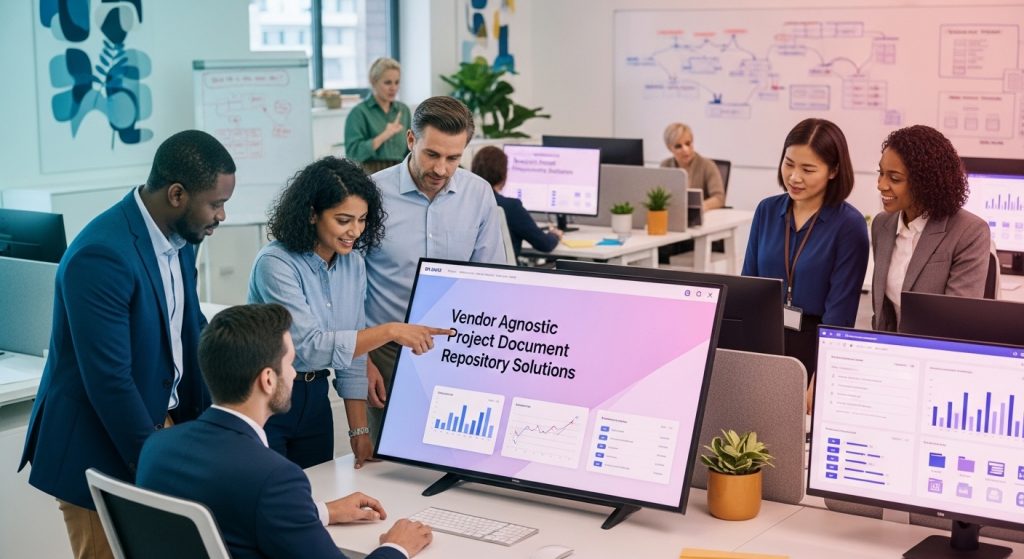
Vendor-Agnostic Project Document Repository Solutions
Document management doesn’t have to be complicated. Yet in most organizations, it somehow becomes a tangled web of incompatible systems, siloed information, and workflow bottlenecks. The culprit? Vendor lock-in. When your document repository is tied to a single provider’s ecosystem, you’re essentially putting your company’s information assets in handcuffs.
Key Takeaways: Vendor-Agnostic Project Document Repository Solutions
- Vendor-agnostic document repositories eliminate dependency on single software providers, reducing long-term costs and integration headaches.
- Organizations using multiple document management systems can achieve 40-60% efficiency improvements by implementing a unified repository approach.
- Cross-platform accessibility is essential for modern workplaces where employees use various devices and operating systems.
- The right vendor-neutral solution maintains robust security while eliminating compatibility barriers between departments and external partners.
- DocumentBridge.io specializes in creating seamless connections between disparate document management systems without requiring complete infrastructure overhauls.
By implementing a vendor-agnostic document repository solution, businesses can maintain flexibility while ensuring seamless information flow across departments, regardless of which software each team prefers to use. This approach doesn’t just solve immediate compatibility issues—it creates a future-proof foundation for document management that can evolve with your business needs.
Why Your Business Needs a Vendor-Agnostic Document Repository
- Eliminate dependency on single software providers
- Reduce integration costs between systems
- Future-proof your document management strategy
- Improve cross-departmental collaboration
- Maintain flexibility to adopt best-in-class tools for specific functions
- Simplify compliance across multiple document types
The modern workplace isn’t just diverse in people—it’s diverse in technology. Marketing might swear by Adobe’s creative suite, while accounting lives in QuickBooks and operations manages everything through an industry-specific ERP. Each system generates, stores, and processes documents differently. Without a vendor-agnostic approach, these systems become islands of information that require constant manual intervention to bridge.
A unified document repository that works independently of these various systems creates a single source of truth. It enables teams to continue using their preferred tools while ensuring documents remain accessible, searchable, and properly versioned for everyone. This isn’t just convenient—it’s increasingly becoming a competitive necessity in fast-moving industries.
The Hidden Costs of Vendor Lock-in
When your document management is tied to a single vendor’s ecosystem, costs tend to compound in ways that aren’t immediately obvious. Initial licensing may seem reasonable, but proprietary systems frequently require expensive connectors, customizations, and module add-ons that quickly inflate the total cost of ownership. Worse still, once you’re embedded in a vendor’s ecosystem, they know switching costs are high—giving them leverage to increase prices during renewals.
Beyond direct costs, vendor lock-in creates operational inefficiencies. Documents must be converted between formats, metadata is lost during transfers, and workflows break at system boundaries. One manufacturing client found that their engineers were spending nearly 6 hours weekly just dealing with document conversion issues between their CAD system and their project management platform. Their switch to a vendor-agnostic document repository recovered over 300 hours of productive time annually per engineer.
Access Problems with Mixed Software Environments
The collaborative nightmare begins when team members can’t access each other’s documents. Legal needs to review marketing materials but can’t open the native files. Field technicians need equipment documentation but can’t access the central repository from their mobile devices. Remote workers struggle with VPN connections just to retrieve basic information. These aren’t just annoyances—they create real business friction that impacts everything from customer service to product development timelines.
The problem compounds with external collaboration. Clients, vendors, and partners all have their own document systems and format preferences. Without a vendor-agnostic approach, each external relationship requires its own document handling procedure, creating complexity that inevitably leads to mistakes, missing files, and miscommunication. Organizations that implement vendor-neutral repositories typically report 40-60% improvements in cross-functional collaboration efficiency.
Core Features of Effective Vendor-Agnostic Repositories
Not all document repositories claiming to be “vendor-agnostic” deliver on that promise equally. True platform independence requires specific technical capabilities that enable seamless operation regardless of which systems need to connect. The difference between a genuinely neutral repository and one that merely accommodates a few popular formats can be the difference between transformation and frustration. For a deeper dive into the options available, check out the best document management software.
Universal File Format Support
The foundation of any vendor-agnostic project document repository is its ability to handle virtually any file format without degradation or conversion issues. This goes beyond simply storing files—it means maintaining their integrity, preserving metadata, and ensuring they remain usable regardless of which application created them. Advanced repositories can render previews of over 200 file types directly in the browser, eliminating the need for users to have native applications installed.
When evaluating solutions, look for support beyond the usual suspects like PDF, Office, and image formats. Can the system properly handle specialized formats in your industry? For architectural firms, this might mean AutoCAD files; for multimedia companies, it could be Adobe Creative Suite formats; for manufacturers, perhaps it’s CAD/CAM specifications. True format neutrality means every document type your organization uses remains fully functional within the repository.
Cross-Platform Accessibility
Today’s workforce doesn’t just use different software—they use different devices and operating systems entirely. A proper vendor-agnostic projject document repository provides consistent access whether users are on Windows workstations, Mac laptops, Linux servers, iOS tablets, or Android phones. The interface should adapt appropriately to each device while maintaining core functionality and security controls.
Browser-based access has become the gold standard for cross-platform compatibility, but not all web interfaces are created equal. Look for responsive designs that work well on both large monitors and small screens. The best systems offer native mobile apps for scenarios where browser access isn’t optimal, such as when field workers need to capture and upload documentation at remote sites with limited connectivity.
Standardized Metadata Management
Documents without proper metadata are just digital paper—difficult to find, categorize, or analyze. Vendor-agnostic repositories excel at standardizing metadata across document types, regardless of their origin. This means automatically extracting existing metadata from files while allowing for consistent organization-wide tagging schemes that transcend individual applications.
The most sophisticated systems employ machine learning to enhance metadata automatically. They can recognize document types, extract key information like dates, names, and project codes, and suggest appropriate tags based on content analysis. This reduces the manual burden of metadata management while improving search accuracy and document retrievability.
API Integration Capabilities
No document repository exists in isolation. It must connect with your business systems, from email and communication platforms to CRM, ERP, and project management tools. Robust APIs (Application Programming Interfaces) are what make these connections possible without custom programming or brittle workarounds.
The best vendor-agnostic repositories offer both RESTful APIs and pre-built connectors for popular business applications. They support webhooks for real-time notifications when documents change, and provide developer-friendly documentation that makes custom integrations straightforward. This extensibility ensures your document repository becomes a central hub in your information ecosystem rather than just another silo.
Scalable Storage Architecture
Document volume grows exponentially in most organizations, making scalability a critical consideration. A vendor-agnostic project document repositoy should accommodate this growth without performance degradation or architectural redesigns. The ideal solution separates storage concerns from access mechanisms, allowing you to leverage cost-effective storage options for different document types based on access patterns and retention requirements.
Cloud-native architectures typically offer the most flexible scaling options, with some systems capable of managing billions of documents across multiple storage tiers. On-premises solutions should support distributed storage architectures and content delivery networks to maintain performance as volume increases. The storage approach should also facilitate disaster recovery and business continuity without tying you to proprietary backup mechanisms.
Top Vendor-Agnostic Document Repository Solutions
After evaluating dozens of document management platforms for their vendor neutrality, integration capabilities, and overall performance, several solutions stand out for their ability to create truly agnostic document ecosystems. Each offers distinct advantages depending on your organization’s specific needs and existing technology investments.
1. Alfresco Content Services
Alfresco Content Services provides an open-source foundation with enterprise-grade capabilities. Its strength lies in its flexible deployment options — available as cloud, on-premises, or hybrid implementations — and its comprehensive API approach that makes integration with virtually any business system straightforward. The platform excels at handling high-volume document processing with advanced workflow automation capabilities.
Particularly impressive is Alfresco’s commitment to open standards and its active developer community that continually extends its capabilities. Organizations with complex document workflows and regulatory requirements will appreciate its governance and compliance features, including DoD 5015.02 certification for records management. While the learning curve can be steeper than some commercial alternatives, the platform’s flexibility compensates for the initial complexity.
2. M-Files
M-Files takes a metadata-first approach to document management that fundamentally differs from traditional folder-based systems. Rather than organizing documents by location, M-Files focuses on what documents are through intelligent metadata recognition. This architecture makes it exceptionally good at unifying content across multiple repositories without requiring migration—a key advantage for organizations with existing document investments.
The platform’s AI capabilities automatically categorize and tag documents based on content, creating connections between related items regardless of their origin. Its unified interface can access and manage content from network folders, SharePoint, Dropbox, and other repositories while maintaining version control and access rights. M-Files particularly shines in regulated industries where document control and audit trails are mission-critical.
3. OpenKM
OpenKM delivers an impressive blend of simplicity and capability that makes it accessible for smaller organizations while scaling effectively for larger enterprises. Its clean, intuitive interface requires minimal training while providing sophisticated document management features including OCR, full-text search, and version control. The system offers both community (open source) and professional editions, making it cost-effective for organizations with budget constraints.
Where OpenKM particularly excels is in its automation capabilities—workflows can be configured to route documents based on metadata, content, or user actions without complex programming. The platform also features robust mobile support with dedicated apps for field access to critical documentation. Organizations looking for straightforward implementation with minimal IT overhead often find OpenKM hits the sweet spot between functionality and simplicity.
4. Nuxeo Platform
Nuxeo offers a highly customizable content services platform designed for organizations with complex document management needs. Its architecture is built around microservices and containerization, making it exceptionally adaptable to specific business requirements without sacrificing performance. The platform handles both traditional documents and digital assets like images and videos with equal proficiency.
What separates Nuxeo from many competitors is its ability to manage both structured and unstructured content within the same repository. This makes it particularly valuable for organizations dealing with diverse information types—from contracts and invoices to marketing assets and technical documentation. The platform’s AI capabilities continuously learn from user interactions, improving categorization and search relevance over time.
Integration capabilities are another Nuxeo strength, with pre-built connectors for major business applications and a comprehensive REST API that simplifies custom integrations. While implementation typically requires more technical expertise than some alternatives, the resulting system can be precisely tailored to organizational workflows and information architecture.
5. FileHold
FileHold positions itself as the user-friendly alternative in the enterprise document management space, with an emphasis on rapid deployment and adoption. The system can be installed and configured within days rather than the weeks or months typical of enterprise implementations, making it appealing for organizations looking to quickly solve document management challenges without extensive projects. Despite its emphasis on simplicity, FileHold offers robust security, version control, and workflow automation suitable for regulated environments.
Setting Up Your Vendor-Neutral Document System
Implementing a vendor-agnostic project document repository requires thoughtful planning to ensure a smooth transition and maximum adoption. Success depends as much on your implementation approach as on the technology you select. Organizations that rush deployment often encounter resistance and miss opportunities to optimize their document processes.
Every successful implementation begins with a clear understanding of your current state and desired outcomes. Document management isn’t just a technical challenge—it’s a business transformation that affects how people work daily. Your implementation strategy should address both the technical architecture and the human factors that determine actual usage patterns.
Audit Your Current Document Ecosystem
Before selecting or configuring any new system, thoroughly map your existing document landscape. Identify all the places documents currently reside—shared drives, email systems, cloud storage, desktop folders, and specialized applications. Catalog the types of documents in each location, their formats, volume, and usage patterns. This inventory becomes your migration roadmap and helps identify priority areas for initial implementation.
During this audit, pay special attention to document workflows. How do documents move through your organization? Who creates, reviews, approves, and consumes them? What bottlenecks or friction points exist in current processes? The most successful implementations address these workflow challenges explicitly rather than simply replicating existing structures in a new system. For more insights, explore document management software solutions.
Define Your Integration Requirements
Document integration needs typically fall into several categories: systems that create documents, systems that consume documents, and systems that need document metadata. For each business application in your environment, define exactly what level of integration is required. Some may need deep, bidirectional connections, while others might only need occasional document access.
Create a prioritized integration roadmap based on business impact. Focus first on connections that eliminate manual work, reduce errors, or address compliance requirements. Remember that perfect integration everywhere isn’t necessary immediately—the vendor-agnostic approach allows you to implement incrementally while maintaining a consistent overall architecture.
Create Your Migration Strategy
Document migration is often the most challenging aspect of implementation. Rather than attempting to migrate everything at once, consider a phased approach based on document value and activity levels. Start with actively used documents in high-impact departments, then progressively migrate older and less-frequently accessed materials.
Quality matters more than speed in migration projects. Each document should be reviewed for appropriate metadata, permissions, and completeness before moving to the new system. This is your opportunity to clean house—removing duplicates, updating outdated information, and establishing consistent naming and organization schemes. Tools like DocumentBridge.io can help automate much of this quality control process while maintaining document integrity across systems.
Security Considerations for Multi-Vendor Repositories
Security becomes more complex when documents flow between multiple systems with different security models. Vendor-agnostic repositories must maintain consistent protection across these boundaries without creating gaps or excessive restrictions. Your security architecture should address authentication, authorization, transmission, storage, and audit requirements comprehensively.
Critical Security Elements for Vendor-Agnostic Repositories:
• Unified identity management across all connected systems
• Consistent permission enforcement regardless of access method
• End-to-end encryption for documents in transit
• Granular audit logging of all document activities
• Data loss prevention capabilities that work across boundaries
• Compliance controls that meet your industry’s requirements
Unified Access Controls
The foundation of document security is knowing who can access what under which circumstances. Vendor-agnostic repositories should integrate with your existing identity management systems—whether Active Directory, LDAP, OAuth providers, or SAML-based single sign-on solutions. This integration ensures that user accounts, group memberships, and authentication requirements remain consistent regardless of how users access documents.
Beyond authentication, authorization models must work consistently across different document sources and access methods. Permissions defined in the repository should apply whether a user accesses a document through a web interface, mobile app, or integrated business application. Look for systems that support both role-based permissions and attribute-based access control for maximum flexibility in complex organizations.
Encryption Standards Across Platforms
Document encryption becomes especially important in multi-system environments where files may traverse various networks and storage systems. An effective vendor-agnostic project document repository, implement encryption at multiple levels — protecting documents in transit with TLS/SSL, at rest with strong storage encryption, and optionally at the file level for highly sensitive materials that require additional protection.
For regulated industries, look for repositories that support specialized encryption requirements like FIPS 140-2 validation or hardware security module integration. The best systems make encryption largely transparent to users while maintaining rigorous protection throughout the document lifecycle. Consider solutions that allow encryption key management to remain under your control rather than delegating this critical security function to vendors.
Audit Trail Implementation
When documents move between systems, maintaining a complete activity record becomes challenging. Vendor-agnostic repositories should provide comprehensive audit logging that captures all document interactions—viewing, downloading, editing, sharing, and permission changes—regardless of which connected system initiated the action. These logs should be tamper-resistant and retained according to your compliance requirements.
Advanced audit capabilities go beyond simple logging to provide actionable intelligence. Look for features like unusual access pattern detection, automatic alerts for sensitive document access, and audit dashboards that help security teams quickly identify potential issues. The most sophisticated systems can correlate document activity with other security events to provide a complete picture of information use across your organization.
Real-World Implementation Success Stories
| Organization Type | Challenge | Solution | Results |
|---|---|---|---|
| Manufacturing Conglomerate | 12 different document systems across 8 acquired companies | Unified vendor-agnostic repository with federated search | 68% faster document retrieval, $1.2M annual savings |
| Multi-Office Legal Firm | Incompatible case management systems between offices | Central document repository with practice-specific views | 42% increase in cross-office collaboration |
| Healthcare Network | Regulatory compliance across disparate medical record formats | Standardized metadata architecture with automated compliance checks | Reduced audit preparation time by 76% |
Abstract case studies offer valuable insights, but real implementation stories demonstrate what’s actually possible with vendor-agnostic approaches. Organizations across industries have transformed their document management by breaking free from vendor-specific limitations. These success stories share common themes: initial skepticism, phased implementation, and ultimately, measurable business impact that justified the transition effort.
What’s particularly noteworthy is how these organizations maintained business continuity during their transitions. By implementing vendor-agnostic repositories as integration layers rather than replacement systems, they achieved incremental benefits while minimizing disruption. This approach allowed teams to continue using familiar tools while gradually shifting toward more standardized processes.
The most successful implementations didn’t just replicate existing document processes in new systems—they reimagined how documents should flow through their organizations. They eliminated redundant approvals, automated routine classification tasks, and created self-service access models that reduced IT bottlenecks. The technology enabled these improvements, but the transformational thinking behind them drove the real value.
Manufacturing Sector Case Study
A global manufacturing company struggled with engineering document management across 17 facilities using 5 different CAD systems and 3 separate product lifecycle management platforms. Design changes required manual file conversion, resulting in version control problems and production delays. Their vendor-agnostic implementation focused on creating a unified repository that maintained native file support while standardizing metadata across systems. Engineers could continue using their preferred design tools while gaining visibility into related documentation regardless of format. The results were dramatic: engineering change order processing time decreased by 64%, cross-facility collaboration increased, and manufacturing defects related to documentation errors dropped by 72% within eight months of full deployment.
How a Multi-Office Legal Firm Streamlined Document Access
A growing legal firm with offices in seven cities faced a document management crisis after several mergers. Each office used different case management systems, document templates, and filing methodologies, making cross-office collaboration nearly impossible. Their vendor-agnostic approach created a central repository that integrated with each office’s existing systems while implementing firm-wide metadata standards and security policies. Attorneys could access case documents through their familiar interfaces or a web portal while administrative staff used standardized workflows for document processing. The solution eliminated duplicate document creation, improved client response times, and enabled specialists from different offices to collaborate seamlessly on complex cases—all without forcing disruptive changes to established work patterns.
Future-Proof Your Document Strategy
Document management isn’t a one-time project—it’s an evolving capability that must adapt to changing business requirements, emerging technologies, and shifting compliance landscapes. A truly vendor-agnostic approach creates the flexibility to incorporate new capabilities without major restructuring or data migration projects. Organizations that implement with future adaptability in mind gain sustainable advantages over those focused only on solving today’s problems.
The most forward-thinking organizations view their document repositories as platforms rather than products. They select solutions with open architectures, robust APIs, and strong developer communities that can extend capabilities as needs evolve. This platform mindset ensures that your document infrastructure can incorporate emerging technologies like machine learning, natural language processing, and advanced analytics without requiring wholesale replacement.
Preparing for New File Formats
File formats continue to evolve as applications add capabilities and new communication methods emerge. A vendor-agnostic repository should accommodate new formats without requiring system upgrades or complex conversions. Look for solutions with extensible format handling frameworks that can quickly incorporate support for emerging document types. The best systems separate content parsing from storage mechanisms, allowing format support to expand independently of the underlying repository architecture. This approach ensures that your system can handle whatever document formats your organization adopts in the future, from specialized industry formats to new multimedia content types that haven’t yet been developed.
Adapting to Changing Compliance Requirements
Regulatory requirements for document management continue to expand in scope and complexity, particularly for organizations operating across multiple jurisdictions. GDPR, CCPA, HIPAA, and industry-specific regulations all impose different requirements for document retention, privacy, and access controls. Vendor-agnostic repositories provide the flexibility to adapt to these changing requirements without major restructuring. By centralizing compliance controls while maintaining distributed storage and access, these systems allow organizations to implement new requirements consistently across all document sources. When selecting a solution, prioritize those with configurable retention policies, automated compliance workflows, and comprehensive audit capabilities that can evolve as regulatory landscapes change.
FAQ’s About Vendor Agnostic Project Document Repository Solutions
As organizations consider transitioning to vendor-agnostic document repositories, several common questions arise about implementation requirements, capabilities, and potential challenges. These questions reflect legitimate concerns that should be addressed as part of your planning process. While specific answers depend on your organizational context, these general responses provide a starting point for more detailed discussions.
What exactly makes a document repository “vendor agnostic”?
A truly vendor-agnostic document repository operates independently of any specific software ecosystem, allowing documents to flow freely between different systems without format limitations or vendor-specific dependencies. This independence manifests in several key capabilities: support for virtually any file format without conversion requirements, integration with multiple business applications regardless of their vendors, flexible deployment options across different infrastructure environments, and adherence to open standards rather than proprietary protocols. The repository becomes a neutral hub that connects diverse document sources and consumers without forcing standardization on specific vendor technologies. This neutrality preserves your freedom to select the best applications for each business function while maintaining a unified document management strategy.
How much technical expertise is needed to implement a vendor-neutral system?
Implementation complexity varies significantly based on your chosen solution and integration requirements. Some vendor-agnostic repositories offer simplified deployment options that business users can configure with minimal IT involvement, while others require more technical expertise but provide greater customization capabilities. The key factors determining technical requirements include:
- Deployment model (cloud-based solutions typically require less technical expertise than on-premises implementations)
- Number and complexity of systems requiring integration
- Volume of documents requiring migration and metadata standardization
- Customization requirements for workflows and user interfaces
- Security and compliance requirements specific to your industry
Most organizations find that a hybrid approach works best, with IT handling core infrastructure and integration components while business stakeholders configure department-specific workflows and metadata structures. This collaborative implementation ensures technical soundness while keeping business requirements at the forefront.
For organizations with limited technical resources, managed implementation services from companies like DocumentBridge.io can provide the necessary expertise without requiring permanent staffing changes. These services typically include integration development, migration assistance, and knowledge transfer to ensure your team can maintain the system after initial deployment.
Can vendor-agnostic solutions really match the features of proprietary systems?
- Integration depth with specialized applications
- Industry-specific functionality and compliance capabilities
- Performance optimization for specific document types or workflows
- User experience consistency across different access methods
- Advanced AI features that require specialized document understanding
Modern vendor-agnostic repositories have largely closed the feature gap with proprietary alternatives. In many cases, they now offer capabilities that siloed systems cannot match, particularly around cross-system search, unified metadata management, and workflow automation that spans multiple applications. The open architectures of these systems also enable faster incorporation of emerging technologies like machine learning and natural language processing.
Where specialized features are required, the integration capabilities of vendor-agnostic repositories allow you to incorporate best-of-breed solutions for specific functions while maintaining central document management. For example, you might use a specialized contract analysis tool while keeping those contracts accessible within your broader document ecosystem.
Organizations frequently discover that the business value of unified document access and consistent processes across systems outweighs any minor feature compromises. The ability to find and use information regardless of its origin typically delivers greater productivity benefits than specialized features that only work within siloed environments.
When evaluating solutions, focus on features that directly impact your core business processes rather than comprehensive feature checklists. A system that excels at your most critical document workflows while providing adequate support for secondary functions will deliver more value than one with extensive features that don’t align with your actual requirements.
What are the typical cost savings when switching to a vendor-neutral approach?
Cost benefits from vendor-agnostic repositories typically come from multiple sources rather than simple license fee reductions. Organizations report savings in several categories: reduced integration development and maintenance costs (typically 30-50% lower than maintaining point-to-point connections), decreased document duplication and storage requirements (20-40% reduction in storage costs), improved staff productivity through faster information retrieval (saving 1-3 hours per knowledge worker weekly), lower training costs through familiar interfaces, and improved business agility that allows faster response to market opportunities. The most significant long-term savings often come from avoiding vendor lock-in dynamics that lead to escalating license costs and expensive migration projects when changing systems. While implementation requires initial investment, most organizations achieve positive ROI within 12-18 months through these combined efficiency improvements and cost reductions. For more information on document management, check out document management software.
How do I migrate existing documents without disrupting business operations?
Successful migration to a vendor-agnostic repository follows a phased approach that prioritizes active documents and critical workflows while maintaining access to existing systems during transition. Begin by establishing clear metadata standards and mapping how current document attributes will translate to your new repository structure. This foundation ensures consistency across migrated content regardless of its source.
Rather than attempting a “big bang” migration, implement department by department or document type by document type, starting with areas that will gain the most immediate benefit. During migration, maintain parallel access to both old and new systems while users adjust to new workflows. DocumentBridge.io’s migration tools can help automate this process by synchronizing content between systems during the transition period.
For large document volumes, consider tiered migration strategies that prioritize recent and frequently accessed documents for immediate migration while implementing scheduled transfers for archival materials. This approach focuses resources on content that delivers immediate business value while ensuring comprehensive migration over time.
The most successful migrations incorporate process improvements rather than simply replicating existing structures. Use this opportunity to eliminate redundant approvals, automate routine classification, and implement more intuitive organization schemes. By delivering immediate productivity benefits, these improvements increase user acceptance and accelerate adoption of the new system.
Avoid the trap of expensive vendor lock-in by building a flexible documentation strategy that works with any software you choose.
Our universal adaptability kits give you the power to switch tools without losing your critical project intelligence.
Browse our vendor-neutral resources at https://bestprojectkits.com to take full control of your technology stack today.
===========================================================================
ABOUT THE AUTHOR
Gerard Mohamed is a project management expert with over 30 years of hands-on experience managing high-stakes projects in the petrochemical and marine engineering sectors.
He holds an MBA from Business School Netherlands and a BCom (Hons) with dual majors in Project Management and Advanced Marketing. As a qualified Marine Engineer, Gerard serves as Chairman of the Cape Branch of the South African Institute of Marine Engineers and Naval Architects (SAIMENA) and sits on their National Executive Committee.
Gerard is a fully accredited Facilitator and Assessor for Project Management under South Africa’s SETA and QCTO, and teaches Project Management part-time at two leading business colleges.
After decades of struggling to find practical, field-tested project templates, he created BestProjectKits.com — a comprehensive library of 3,500+ professionally designed templates that solve real-world project challenges across 20+ industries.
→ Explore the complete template library at BestProjectKits.com
→ Connect with Gerard: [admin@bestprojectkits.com]
=========================================================================