
Centralized Project Document Repository Best Practices 2026
Key Takeaways: Centralized Project Document Repository Best Practices
- Organizations implementing centralized document repositories reduce project delays by up to 35% and increase team productivity by 27% according to 2025 PMI data.
- AI-powered search capabilities are now mandatory for modern document repositories, with 92% of high-performing teams using semantic search features.
- A well-structured permission hierarchy that balances security with accessibility is the foundation of effective document management.
- Version control systems with automated conflict resolution now save project teams an average of 7.3 hours per week previously lost to version confusion.
- GoSearch provides unified document access across multiple platforms, eliminating silos while maintaining existing workflows, making it the ideal solution for complex project environments.
The days of hunting through email threads, searching across network drives, or asking “Who has the latest version?” are finally behind us. At least, they should be. Yet in 2026, project teams are still wasting valuable time managing document chaos instead of driving deliverables forward. The difference between high-performing organizations and those struggling with deadlines often comes down to one critical factor: how effectively they manage their project documentation.
The Hidden Costs of Document Chaos in 2026
The financial impact of poor document management extends far beyond the obvious frustrations. When examining the true cost of decentralized, unstructured document storage, the numbers are staggering. Organizations without proper document repository systems face productivity losses equivalent to 9.3 weeks per employee annually. This translates to approximately $28,000 per knowledge worker in wasted salary costs alone.
Why Project Teams Still Waste 30% of Time Searching for Files
Despite technological advances, the average project professional spends nearly one-third of their working hours searching for information across disparate systems. The proliferation of collaboration tools has paradoxically created more silos, not fewer. Teams toggle between SharePoint, Google Drive, local network folders, email attachments, and messaging platforms like Slack or Teams. Each platform contains critical project documents with no unified search capability, creating a digital maze that drains productivity and morale. GoSearch addresses this exact pain point by providing unified search across all platforms, dramatically reducing time wasted on document hunting.
Security Breaches from Scattered Documents Cost Companies $4.5M Annually
When documents live everywhere, security becomes an afterthought. The average data breach now costs organizations $4.5 million, with unsecured document sharing being a primary vector. Shadow IT practices—where team members use unauthorized cloud storage or transfer methods to circumvent cumbersome official systems—create security vulnerabilities that cybercriminals readily exploit. Without centralized control, sensitive project documents often lack proper encryption, access controls, or monitoring, leaving intellectual property and confidential information exposed to both internal and external threats.
Compliance Penalties That Could Have Been Avoided
Regulatory requirements continue to tighten across industries. From GDPR and CCPA to industry-specific regulations like HIPAA and FDA 21 CFR Part 11, organizations face serious penalties for improper document handling. In 2025 alone, companies paid over $1.8 billion in fines for compliance failures related to document management. Most troubling is that 78% of these penalties were entirely preventable with proper document repository controls. The ability to demonstrate document chain of custody, approval workflows, and access logs has become non-negotiable for regulated industries.
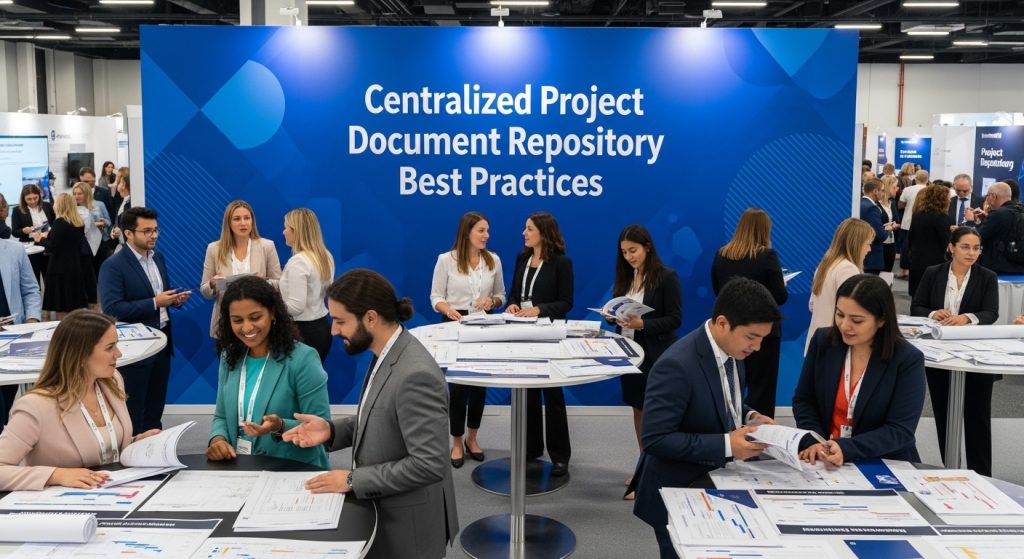
Core Elements of Effective Centralized Repositories
Implementing a centralized document repository isn’t simply about choosing a platform and migrating files. The most effective systems balance technical capabilities with human factors, creating an ecosystem that enhances work rather than complicating it. Modern project document repositories must seamlessly integrate into existing workflows while providing the structure and security organizations require.
Cloud-Native Architecture vs. Traditional Storage Solutions
The debate between on-premises and cloud-based repositories has largely been settled. Cloud-native architectures now dominate the document management landscape, offering superior scalability, accessibility, and disaster recovery capabilities. Modern solutions leverage containerization and microservices to provide 99.99% uptime guarantees and unlimited storage potential. However, hybrid approaches remain viable for organizations with specific compliance requirements or legacy systems that cannot be fully migrated. The key is selecting an architecture that provides anywhere access while maintaining appropriate security controls and performance standards.
AI-Powered Search and Retrieval
Basic keyword search is no longer sufficient for modern document repositories. AI-powered semantic search has revolutionized how teams find information by understanding context and intent rather than exact term matching. Leading systems now utilize natural language processing to extract meaning from documents, recognize entities, and connect related content across the repository. This enables team members to find information based on concepts rather than specific keywords, dramatically improving discovery efficiency. Advanced systems even anticipate user needs by surfacing relevant documents based on project context, upcoming meetings, and historical access patterns.
Version Control That Actually Works
Version control has evolved dramatically from simple date-stamped filenames to sophisticated systems that track every change with granular detail. Modern repositories now employ blockchain-inspired immutable audit trails that capture who changed what and when, creating a permanent record that cannot be altered retroactively. The most effective systems automatically detect content conflicts when multiple users edit simultaneously, providing intelligent merge suggestions rather than forcing manual reconciliation. This prevents the “final_FINAL_v2_APPROVED” filename syndrome that plagued earlier document management approaches.
Metadata Management Strategies
Metadata has become the backbone of effective document repositories, transforming unstructured content into structured, searchable assets. Leading organizations now implement multi-layered metadata frameworks that combine system-generated attributes (creation date, file type, size) with project-specific tags (phase, deliverable type, approval status). The most sophisticated systems employ machine learning to automatically suggest and apply metadata based on content analysis, reducing the manual tagging burden while improving consistency. This rich metadata layer enables powerful filtering, sorting, and relationship mapping that makes finding the right document intuitive and fast.
Seamless Integration With Project Management Tools
The days of document management existing as a separate silo are over. Today’s most effective repositories integrate deeply with project management platforms, creating bidirectional relationships between tasks, timelines, and documentation. When a task status changes in the project management tool, related documents automatically update their workflow stage. Similarly, when documents reach approval milestones, task completions are automatically triggered. This integration eliminates the manual synchronization that previously consumed valuable project management time and reduces the risk of work proceeding based on outdated information.
Setting Up Your Repository Structure
The foundation of an effective document repository lies in its organizational structure. A well-designed hierarchy balances intuitive navigation with scalable growth potential, ensuring the system remains useful as project complexity increases. The most successful implementations begin with a thorough analysis of information flows, user needs, and regulatory requirements before building the structure.
1. Document Classification Framework
A robust classification system forms the backbone of any effective repository. The most advanced organizations implement multi-dimensional taxonomies that move beyond simple folder hierarchies to create relationship-based classification. This approach enables documents to exist in multiple logical locations without duplication, supporting different access patterns based on user role and need. The ideal framework balances specificity with flexibility, allowing for consistent organization while accommodating the unique needs of different project types. Classification should align with how teams actually work rather than imposing arbitrary structures that force users to adapt their thinking.
2. Naming Conventions That Scale
File naming conventions have evolved from simple guidelines to sophisticated systems that embed meaningful metadata directly in filenames. Modern approaches utilize structured patterns that combine project codes, document types, revision numbers, and status indicators in machine-readable formats. Leading organizations automate filename generation through templates integrated into document creation workflows, ensuring consistency while reducing user burden. The most effective conventions balance human readability with machine parsing capabilities, supporting both browsing and automated processing.
3. Permission Hierarchy Development
Access control has transformed from basic read/write permissions to nuanced role-based systems that align with organizational responsibilities. Progressive organizations implement attribute-based access control (ABAC) that dynamically adjusts permissions based on document status, user role, project phase, and even location or time of access. This granular approach ensures sensitive information remains protected while avoiding the excessive restrictions that drive shadow IT practices. The key is striking the balance between security and accessibility – making appropriate information available to those who need it without creating unnecessary barriers.
4. Workflow Automation Rules
Static repositories have given way to dynamic systems that actively guide documents through their lifecycle. Modern workflow automation incorporates conditional logic, parallel approval paths, and escalation procedures that keep documents moving through review and approval processes without manual intervention. The most sophisticated systems adapt workflows based on document content, automatically routing technical specifications to engineering reviewers while sending contractual documents to legal teams. These intelligent workflows reduce bottlenecks, provide visibility into document status, and ensure consistent processing regardless of personnel changes.
5. Retention Policy Configuration
Document retention has evolved from simple time-based rules to context-aware policies that consider regulatory requirements, operational value, and legal risk. Advanced repositories now implement automated classification that applies appropriate retention schedules based on document content analysis, reducing the risk of premature deletion or unnecessary storage costs. Leading systems integrate with legal hold mechanisms that can override normal retention schedules when litigation or investigations arise. The most effective policies balance compliance requirements with practical storage considerations, ensuring important information remains accessible without creating unmanageable digital archives.
Security Protocols for 2026 Standards
Security requirements have intensified dramatically as threats become more sophisticated and regulatory penalties more severe. Modern document repositories must implement defense-in-depth strategies that protect content throughout its lifecycle – from creation through sharing, storage, and eventual disposition. The most secure systems now incorporate behavioral analytics that detect unusual access patterns and automatically escalate potential security incidents for investigation.
Zero-Trust Architecture Implementation
The perimeter-based security model has been replaced by zero-trust architectures that verify every access attempt regardless of source. Modern document repositories implement continuous authentication that monitors user behavior throughout sessions, not just at login. This approach incorporates contextual factors like device security posture, network characteristics, and behavioral patterns to make dynamic access decisions. Leading systems now utilize risk-based authentication that escalates verification requirements when suspicious patterns emerge – requiring additional factors for sensitive operations while maintaining usability for routine access.
Quantum-Resistant Encryption Requirements
As quantum computing capabilities advance, traditional encryption algorithms face obsolescence. Forward-thinking organizations are already implementing post-quantum cryptography to protect sensitive documents against future decryption capabilities. The most secure repositories now employ hybrid encryption approaches that combine current standards with quantum-resistant algorithms, ensuring protection that will withstand emerging computational threats. This proactive approach is especially critical for long-lived documents whose confidentiality must be maintained for decades – including intellectual property, strategic plans, and regulated information.
Biometric Access Controls
Password-based authentication has given way to multi-factor approaches that incorporate biometric verification. Advanced document repositories now support facial recognition, fingerprint scanning, and even behavioral biometrics that analyze typing patterns or mouse movements to confirm user identity. The integration of hardware security keys provides additional protection against sophisticated phishing attacks that might otherwise compromise traditional credentials. These enhanced authentication mechanisms balance security with usability, reducing friction while significantly raising the bar for unauthorized access attempts.
The proliferation of remote work has made device security a critical component of document protection. Leading repositories implement endpoint security requirements that verify device compliance before granting access to sensitive content. This includes checking for current operating system patches, antivirus status, disk encryption, and secure configuration settings. Documents downloaded to approved devices can include persistent protection that maintains access controls even when offline, preventing unauthorized sharing or screenshot captures.
Internal threats now account for over 60% of document security incidents, making insider risk management essential. Advanced repositories implement content surveillance that detects unusual download patterns, monitors mass file access, and flags suspicious activity like accessing documents outside normal working hours or from unusual locations. These capabilities help identify potential data exfiltration before sensitive information leaves the organization, providing security teams with early warning of possible insider threats.
Collaboration Features That Drive Adoption
The most advanced document repositories have evolved beyond passive storage into active collaboration hubs. The difference between successful implementations and failed initiatives often comes down to user adoption, which is primarily driven by collaboration features that make teamwork more efficient. Organizations implementing repositories without robust collaboration capabilities typically see adoption rates below 40%, while those with comprehensive collaborative tools achieve over 85% user engagement.
Real-Time Co-Authoring Tools
Gone are the days of checking out documents and working in isolation. Modern repositories now offer simultaneous editing capabilities that rival dedicated collaboration platforms like Google Workspace. Teams can now see each other’s changes in real-time, with cursor presence indicators showing exactly who is working on which section. The most sophisticated systems integrate conflict resolution algorithms that automatically merge non-conflicting changes while highlighting areas that require human decision-making. This capability has reduced document completion times by an average of 62% across industries while improving content quality through immediate peer input.
The collaboration experience now extends beyond text documents to include specialized file types like CAD drawings, BIM models, and complex spreadsheets. Previously, these specialized formats required dedicated applications that limited real-time collaboration. Today’s advanced repositories leverage browser-based rendering and specialized web components to enable collaborative editing of these complex file types without requiring desktop software installation. For more insights on creating a centralized document repository for projects, check out this article.
Comment Threading and Resolution
The review process has been transformed by intelligent comment systems that go far beyond simple annotations. Modern repositories implement threaded discussions attached to specific document elements, allowing focused conversations about particular content without cluttering the document itself. These systems support structured workflows where comments can be assigned, prioritized, and tracked through resolution. Advanced platforms now incorporate AI assistants that can suggest potential resolutions to common comments, accelerating the review cycle while improving consistency.
Mobile-First Access Design
As project work becomes increasingly distributed, mobile access has evolved from a convenience to a necessity. Leading repositories now implement responsive interfaces that provide full functionality across devices, not just limited “mobile versions” with reduced capabilities. The most effective systems utilize progressive web application techniques that provide native-like experiences including offline access, push notifications for document updates, and touch-optimized interfaces. These capabilities ensure team members can meaningfully contribute regardless of location or device, supporting the hybrid work models that now dominate project environments.
Meeting Integration Capabilities
The artificial separation between meetings and documentation has disappeared in modern repositories. Advanced systems now integrate directly with video conferencing platforms, automatically surfacing relevant documents during scheduled discussions. During meetings, team members can access, edit, and reference repository content without switching contexts, while meeting notes are automatically linked to relevant project documents. The most sophisticated platforms even capture meeting transcripts, extract action items, and link these directly to affected documents, creating a seamless connection between discussions and deliverables.
Migration Strategies for Legacy Systems
The transition from legacy document management to modern repositories represents one of the most challenging aspects of implementation. Organizations frequently underestimate both the technical complexities and change management requirements involved. Successful migrations balance technology transformation with human factors, recognizing that even the most sophisticated repository will fail if users resist adoption or critical information is lost in transition.
Data Cleansing Before Migration
The “lift and shift” approach to document migration inevitably reproduces existing problems in the new environment. Progressive organizations now implement pre-migration analysis and cleansing to identify redundant, obsolete, and trivial (ROT) content before transfer. Advanced content analysis tools can identify near-duplicates, outdated versions, and documents with little business value, allowing organizations to reduce migration volume by 30-50%. This not only accelerates the migration process but also ensures the new repository starts with high-quality, relevant content that improves search precision and user experience. For more insights on creating a centralized repository, check out this guide on how to create a centralized document repository.
Phased vs. Flash Cut Approaches
The migration strategy must balance disruption risk against operational continuity. Flash-cut transitions offer clean breaks but create significant productivity impacts during the cutover period. Phased migrations reduce immediate disruption but extend the timeline during which teams must work across multiple systems. The most effective approaches combine these methods, using phased migrations for most content while scheduling strategic flash-cut transitions during natural business slowdowns. Hybrid synchronization tools can maintain bidirectional updates between old and new systems during transition phases, ensuring users always have access to current information regardless of which system they access.
User Training During Transition
Traditional classroom training has proven ineffective for repository implementations, with knowledge retention below 20% after just one week. Leading organizations now implement contextual learning approaches that deliver bite-sized training within the workflow when users need specific functionality. These just-in-time training modules are supplemented by role-based learning paths that focus on each user’s specific needs rather than generic system capabilities. The most successful implementations incorporate gamification elements that reward exploration and proficiency, turning the learning process into an engaging experience rather than an obligation.
AI Capabilities Transforming Document Management
Artificial intelligence has revolutionized document management, transforming repositories from passive storage into proactive knowledge systems. Modern AI capabilities extend far beyond basic automation, actively enhancing how teams create, find, and utilize information. Organizations implementing AI-enhanced repositories report productivity gains averaging 37% compared to traditional systems, with even higher improvements for knowledge-intensive projects.
Automated Tagging and Classification
Manual metadata application has been replaced by intelligent systems that automatically analyze document content and apply appropriate tags. These AI systems recognize entities, concepts, and relationships without human intervention, ensuring consistent classification across the repository. Advanced implementations utilize domain-specific models trained on industry terminology, recognizing specialized concepts like project risks, contractual obligations, or technical specifications. This automatic classification dramatically improves search precision while eliminating the metadata maintenance burden that previously consumed valuable team time.
The most sophisticated systems now implement continuous learning loops that refine classification accuracy based on user behavior. When users modify auto-generated tags or search for documents using unexpected terms, the system incorporates this feedback to improve future classification decisions. This adaptive approach ensures the repository becomes increasingly aligned with how teams actually think about and search for information, rather than forcing users to adapt to rigid taxonomies.
Content Summarization Features
As document volumes grow, the ability to quickly grasp key information without reading entire files has become essential. Modern repositories now employ extractive and generative AI to create concise summaries of documents, highlighting critical points while maintaining contextual accuracy. These summaries appear in search results and document previews, allowing team members to quickly determine relevance before investing time in full review. The most advanced systems generate different summary types based on user role – technical summaries for specialists, executive overviews for leadership, and action-oriented summaries for project managers.
Predictive Document Retrieval
Passive repositories that wait for search queries have been replaced by predictive systems that anticipate information needs. These intelligent systems analyze user context – including current projects, upcoming meetings, and recent activities – to proactively suggest relevant documents. For example, when a team member opens a design specification, the system might automatically surface related requirements documents, previous version comparisons, and recent feedback. This predictive approach reduces search time by 72% on average while ensuring critical connections between related documents aren’t overlooked due to search blind spots.
Natural Language Processing for Advanced Search
Keyword search has evolved into sophisticated natural language understanding that interprets questions and intent rather than matching exact terms. Modern repositories allow users to ask complex questions like “What were the main objections raised during the last client review?” or “Show me all schedule delays caused by material shortages” without constructing Boolean queries. These semantic search capabilities bridge the gap between how humans think and how information is stored, dramatically improving the repository experience for non-technical users. The most advanced implementations incorporate domain-specific language models that understand industry jargon and specialized terminology, further enhancing search precision.
Measuring Repository ROI
Justifying investment in document repositories requires moving beyond vague productivity claims to concrete ROI metrics. Organizations that successfully secure continued investment and executive support implement comprehensive measurement frameworks that capture both tangible and intangible benefits. These metrics not only validate initial implementation decisions but also guide ongoing optimization efforts by identifying high-value capabilities that deserve further investment.
Time Savings Metrics
Time recovery represents the most immediate and measurable repository benefit. Advanced organizations track specific time-saving categories including search time reduction, approval cycle acceleration, and onboarding efficiency improvements. The most sophisticated measurement approaches combine system analytics (capturing actual search and retrieval times) with periodic time studies that quantify end-to-end process improvements. These metrics typically show that team members recover 7-12 hours weekly through improved document access – time that can be redirected to higher-value activities.
Beyond raw time savings, leading organizations measure effort displacement – how repository capabilities allow teams to shift time from low-value administrative tasks to high-value creative and strategic work. This measurement approach recognizes that the true benefit isn’t just doing the same work faster but enabling fundamentally different work allocation. For example, when project managers spend less time tracking down and distributing documents, they can invest more in risk management and stakeholder engagement activities that directly impact project outcomes.
Quality improvement metrics capture how repositories enhance deliverable excellence beyond mere time efficiency. By tracking error reduction, consistency improvements, and knowledge reuse rates, organizations can demonstrate how centralized repositories improve project outcomes. The most comprehensive measurement frameworks correlate repository usage patterns with project success metrics, showing that teams with high repository engagement typically deliver projects with 23% fewer defects and 18% higher client satisfaction scores.
Collaboration Efficiency Indicators
Beyond individual productivity, effective repositories dramatically improve team collaboration efficiency. Leading organizations track metrics including review cycle time reduction, cross-functional engagement levels, and knowledge transfer effectiveness. These indicators help quantify how repositories break down information silos and enable true collaborative work patterns. The most compelling ROI calculations incorporate opportunity cost analysis – demonstrating how faster document-driven processes allow organizations to pursue more projects, respond to market changes more quickly, or capitalize on time-sensitive opportunities that would otherwise be missed.
Risk Reduction Valuation
The risk mitigation value of proper document management often exceeds direct productivity benefits. Forward-thinking organizations quantify risk reduction through metrics including compliance violation prevention, intellectual property protection improvement, and litigation exposure reduction. By working with risk management teams to assign financial values to these risk categories, repository champions can demonstrate substantial “insurance value” beyond operational efficiencies. The most sophisticated approaches incorporate expected value calculations that multiply risk reduction percentages by potential impact costs, creating defensible valuations for previously intangible benefits.
Your 90-Day Implementation Roadmap
Successful repository implementations follow a structured approach that balances technical configuration with organizational change management. The most effective implementations proceed in three phases: discovery and planning (days 1-30), core implementation (days 31-60), and expansion and optimization (days 61-90). This phased approach delivers early wins that build momentum while establishing the foundation for long-term success. Each phase includes specific technical deliverables, user engagement activities, and governance development to ensure balanced progress across all implementation dimensions.
Frequently Asked Questions About Centralized Project Document Repository Best Practices
As organizations navigate repository implementation decisions, certain questions consistently arise. Addressing these common concerns proactively helps build stakeholder alignment and reduces implementation friction. The following responses reflect current best practices based on successful implementations across industries.
How much does a centralized document repository typically cost in 2026?
Repository costs have evolved from simple per-user licensing to more nuanced value-based pricing models. For cloud-based solutions, organizations typically invest $18-45 per user monthly depending on functionality requirements and storage needs. On-premises solutions generally require $75,000-250,000 initial investment for mid-sized implementations (250-1000 users) plus ongoing maintenance costs of 15-20% annually. However, focusing solely on technology costs misses the full financial picture. Implementation services typically add 1-2× the software cost, while internal resource allocation for configuration, migration, and change management often represents the largest investment component. The most accurate TCO calculations include user adoption costs, integration expenses, and productivity impacts during transition phases.
What’s the biggest mistake companies make when implementing document repositories?
The most common implementation failure stems from treating document repositories as technology projects rather than organizational change initiatives. Technical capabilities matter little if users continue working in legacy systems or create shadow IT solutions to circumvent new processes. Successful implementations allocate at least 30% of project resources to change management, user training, and adoption activities – engaging users from initial planning through implementation and optimization phases.
Another critical mistake is forcing rigid repository structures that don’t align with how teams actually work. Organizations that impose theoretical information architectures without considering existing workflows and mental models typically see adoption rates below 40%, regardless of technical capabilities. The most successful implementations take an adaptive approach, starting with how teams currently organize information and gradually introducing improvements rather than demanding immediate behavioral changes.
Implementation Failure Warning Signs
- Technical team leads implementation without business representation
- No executive sponsor with authority across affected departments
- Migration plan focuses on moving all content without quality assessment
- Training scheduled as one-time events rather than ongoing support
- Success metrics focus on system deployment rather than business outcomes
Organizations that approach repository implementations with technology-centric thinking inevitably struggle with user adoption and fail to realize expected benefits. Successful initiatives are characterized by balanced teams that combine technical expertise with deep understanding of business processes and user needs. The most effective implementations maintain this balance throughout the project lifecycle, adjusting the approach based on user feedback rather than rigidly following initial plans.
Finally, many organizations underestimate the importance of data governance in repository success. Without clear ownership, quality standards, and lifecycle management policies, repositories quickly become as chaotic as the file shares they replaced. Leading implementations establish governance frameworks before migration begins, ensuring the new environment maintains information integrity from day one.
Can a document repository work without changing our current workflows?
The most successful repository implementations balance workflow optimization with change management realities. While some workflow adjustment is inevitable, modern repositories are increasingly designed to accommodate existing processes rather than forcing wholesale changes. The key is identifying which current workflows add value versus those that exist only because of technical limitations. Value-adding processes can often be preserved while eliminating unnecessary steps created by information silos or access limitations. Solutions like GoSearch specifically address this challenge by providing unified search and access across existing platforms, allowing organizations to maintain current storage locations while dramatically improving findability and collaboration capabilities.
How do I convince leadership to invest in a proper document management system?
Securing executive support requires translating document management capabilities into business outcomes leadership already values. Effective business cases focus on three primary value categories: cost reduction through efficiency gains, risk mitigation through improved compliance and security, and revenue opportunities through faster project completion and improved quality. The most compelling proposals quantify current costs of document chaos through time studies showing how much skilled professionals currently spend on low-value document tasks. This approach frames repository investment as capability enhancement rather than cost, demonstrating how improved information management directly enables strategic business goals like accelerated time-to-market, improved customer experience, or enhanced decision quality.
What skills should I look for when hiring a document management administrator?
The document management administrator role has evolved from technical custodian to strategic information architect. The most effective administrators combine technical capabilities with business process understanding and change management skills. Technical requirements now extend beyond system configuration to include integration expertise, automation development, and data analysis capabilities. However, technical skills alone are insufficient – successful administrators must also possess strong communication abilities, stakeholder management experience, and process improvement mindsets. The most valuable team members bring domain knowledge that allows them to understand how information flows through business processes, enabling them to design repository structures and workflows that align with actual work patterns rather than theoretical ideals.
When building document management teams, leading organizations prioritize diverse skill combinations rather than deep specialization in any single area. This approach creates adaptable teams that can address the full spectrum of repository challenges from technical configuration to user adoption. Increasingly, organizations are developing these capabilities internally through structured development programs rather than external hiring, recognizing that domain knowledge combined with technical training often produces more effective results than pure technical expertise without business context.
The document chaos that characterized early digital transformation has finally given way to intelligent information management that truly enables project success. By implementing these best practices, organizations can transform document repositories from necessary overhead into strategic assets that accelerate delivery, improve quality, and enhance team collaboration. The organizations that master these capabilities gain significant competitive advantage through faster decision-making, reduced rework, and more effective knowledge utilization.
Creating a centralized project document repository is essential for efficient project management. It ensures that all team members have access to the latest documents and can collaborate effectively.
To learn more about setting up a centralized document repository, you need to stop guessing at the perfect folder structure and start implementing a proven system that scales with your ambition.
Our comprehensive setup guides and architectural blueprints eliminate the trial and error of building a centralized hub from scratch. Head over to https://bestprojectkits.com to access the master kit that defines modern project management excellence.
===========================================================================
ABOUT THE AUTHOR
Gerard Mohamed is a project management expert with over 30 years of hands-on experience managing high-stakes projects in the petrochemical and marine engineering sectors.
He holds an MBA from Business School Netherlands and a BCom (Hons) with dual majors in Project Management and Advanced Marketing. As a qualified Marine Engineer, Gerard serves as Chairman of the Cape Branch of the South African Institute of Marine Engineers and Naval Architects (SAIMENA) and sits on their National Executive Committee.
Gerard is a fully accredited Facilitator and Assessor for Project Management under South Africa’s SETA and QCTO, and teaches Project Management part-time at two leading business colleges.
After decades of struggling to find practical, field-tested project templates, he created BestProjectKits.com — a comprehensive library of 3,500+ professionally designed templates that solve real-world project challenges across 20+ industries.
→ Explore the complete template library at BestProjectKits.com
→ Connect with Gerard: [admin@bestprojectkits.com]
=========================================================================