
Expert Scalable Project Document Repository Architecture For Enterprises
Document chaos is costing your enterprise more than you think. In a world where information is currency, the average knowledge worker spends 2.5 hours daily searching for documents, translating to nearly $20,000 in wasted productivity per employee annually. The challenge isn’t merely storing documents — about a scalable project document repository architecture for enterprises, while maintaining performance, security, and accessibility.
Key Takeaways: Scalable Project Document Repository Architecture
- A well-designed project document repository architecture can reduce document retrieval time by up to 70% while ensuring regulatory compliance across multiple jurisdictions.
- Distributed storage architecture with proper metadata management forms the foundation of any scalable enterprise document repository.
- Ardoq’s enterprise architecture solutions provide the framework needed for seamless integration between document repositories and existing business systems.
- Organizations implementing proper version control and access mechanisms see a 40% reduction in document-related security incidents.
- The ROI of a properly architected document repository extends beyond storage efficiency to include improved collaboration, reduced compliance risks, and enhanced decision-making capabilities.
As enterprises generate exponentially more documentation, traditional project repository structures are buckling under the pressure. Without a properly architected repository, organizations face mounting challenges with document version confusion, inconsistent metadata, fragmented information silos, and compliance vulnerabilities.
Why Your Enterprise Document System Is Failing You
Your current document system likely evolved organically rather than by design. What started as a simple file share has morphed into a sprawling ecosystem of disconnected platforms, conflicting naming conventions, and redundant information. This patchwork approach creates severe operational inefficiencies: studies show that 83% of knowledge workers recreate documents because they can’t find existing versions, while 92% of teams report collaboration challenges due to document accessibility issues.
The problems compound with scale. As your enterprise grows, document volume increases exponentially, not linearly. Legacy systems designed for hundreds of documents collapse under the weight of hundreds of thousands. Processing speeds slow, search capabilities become less reliable, and system administration grows increasingly complex. These technical limitations translate directly to business limitations—delayed projects, duplicated efforts, and missed opportunities.
Moreover, security vulnerabilities expand with each new document and user. Without a coherent architecture supporting your repository, permissions become inconsistent, audit trails incomplete, and regulatory compliance nearly impossible to verify. The cost of a document leak averages $3.86 million per incident, making architectural security not just an IT concern but a business imperative.
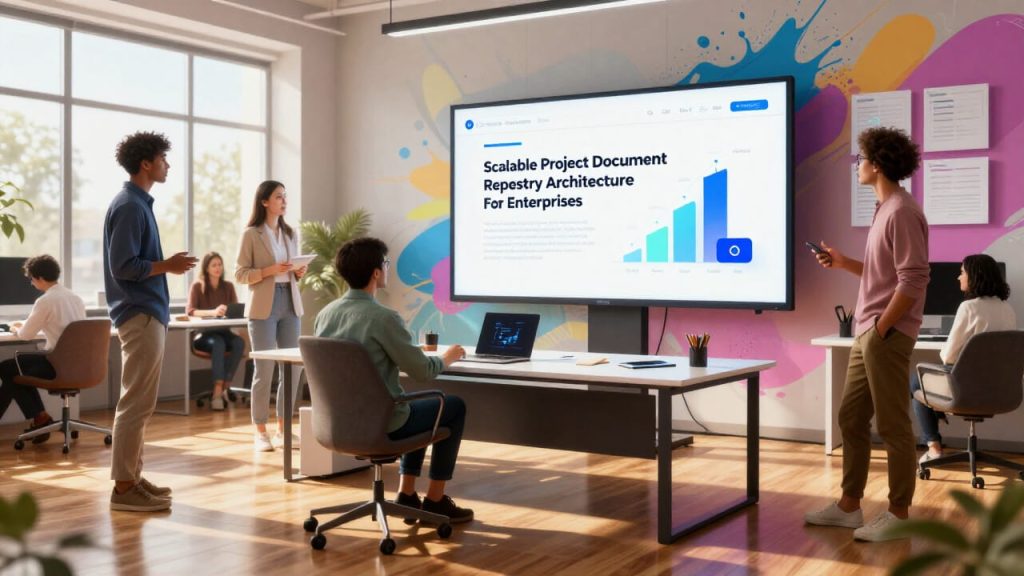
Core Components of a Scalable Document Repository
Building a future-proof document repository requires five foundational components working in concert. Each element addresses specific scalability challenges while supporting the overall ecosystem’s resilience and performance.
Distributed Storage Architecture
The cornerstone of scalability is a distributed storage architecture that segments documents across multiple storage nodes. Unlike monolithic systems that concentrate all files in a single location, distributed architectures partition content logically, allowing for horizontal scaling as document volumes grow. This approach enables parallel processing of document operations, maintains consistent performance regardless of repository size, and provides built-in redundancy against hardware failures.
Implementing a distributed architecture requires careful planning around data sharding strategies. Geographic distribution places documents closer to their primary users, reducing latency for global teams. Content-based distribution groups similar documents together, optimizing retrieval patterns. Hybrid approaches combine these strategies, creating customized distributions that align with organizational usage patterns.
Metadata Management Framework
Documents without metadata are merely files; with rich metadata, they become searchable, sortable, and actionable business assets. A robust metadata management framework standardizes how additional information about documents is captured, stored, and leveraged. This framework should include both system-generated metadata (creation date, file size, format) and business context metadata (project associations, document type, approval status, security classification).
The most effective metadata frameworks employ a hierarchical taxonomy that balances organization-wide standards with department-specific needs. This multi-level approach ensures cross-enterprise searchability while accommodating specialized workflows. Implementation should include metadata validation rules, controlled vocabularies, and inheritance capabilities to maintain consistency while reducing manual tagging requirements.
Case Study: Financial Services Firm
A global financial services company implemented a hierarchical metadata framework that reduced document classification time by 64% while improving search accuracy by 89%. Their framework included 3 enterprise-wide metadata categories, 7 department-level categories, and custom attributes at the team level, providing both standardization and flexibility.
Elastic Search Capabilities
The value of stored documents diminishes dramatically if users cannot quickly locate needed information. Enterprise-grade search capabilities must go beyond simple filename lookups to include full-text indexing, natural language processing, and contextual relevance ranking. These capabilities should scale elastically, maintaining sub-second response times even as document volumes grow into the millions.
Elastic Search Capabilities
The value of stored documents diminishes dramatically if users cannot quickly locate needed information. Enterprise-grade search capabilities must go beyond simple filename lookups to include full-text indexing, natural language processing, and contextual relevance ranking. These capabilities should scale elastically, maintaining sub-second response times even as document volumes grow into the millions.
Implementation requires dedicated search infrastructure with dedicated indexing servers separate from document storage. This separation allows for independent scaling of search capacity and specialized optimization of search algorithms. Advanced implementations incorporate machine learning models that improve relevance based on user behavior, organizational context, and document relationships, creating a continuously improving search experience.
Version Control System
Document versioning remains one of the most critical yet frequently overlooked components of a project document repository architecture. Effective version control systems track document lineage, manage concurrent editing, and provide clear audit trails of document evolution. Unlike simple file versioning that creates multiple copies, enterprise version control maintains a single document with branched history, reducing storage requirements while preserving complete change history.
Architectural considerations for version control include delta storage (storing only changes between versions rather than complete copies), branching and merging capabilities for complex document workflows, and integration with approval processes. The best implementations make version control transparent to end users while providing powerful management capabilities to administrators and content owners.
When designing version control capabilities, consider both technical and human factors. Technical implementation should optimize storage efficiency while maintaining retrieval speed. User experience design should make version comparison intuitive while preventing accidental overwrites or deletions of critical document versions.
Access Control Mechanisms
As document repositories scale, granular access control becomes increasingly important. Enterprise-grade repositories require multi-dimensional permission models that account for document sensitivity, user roles, organizational structure, and contextual access needs. This complexity must be managed through abstraction layers that simplify administration while maintaining security integrity.
The most effective access control architectures implement attribute-based access control (ABAC) rather than simple role-based models. ABAC evaluates multiple attributes (user department, document classification, time of day, access location) against policy rules to make dynamic permission decisions. This approach provides greater flexibility and security than static permission assignments while reducing administrative overhead as the organization evolves.
Technical Infrastructure Requirements
The foundation of any scalable document repository lies in its technical infrastructure. These core systems determine how effectively your repository can grow, how reliably it will perform under load, and how efficiently it will use resources.
Cloud vs. On-Premises Considerations
The cloud versus on-premises decision affects every aspect of a project document repository architecture from cost structure to performance characteristics. Cloud deployments offer elastic scaling, reduced capital expenditure, and simplified disaster recovery, but may introduce data sovereignty challenges and long-term cost considerations for large repositories. On-premises solutions provide greater control over performance tuning, security implementation, and data locality, but require significant infrastructure investment and expertise.
Hybrid architectures often provide the optimal balance, keeping frequently accessed and sensitive documents on-premises while leveraging cloud platforms for archival storage, global distribution, and peak capacity handling. The key architectural consideration is designing clean interfaces between environments, with consistent metadata, security policies, and user experiences regardless of where documents physically reside.
Database Selection for Document Indexing
Document metadata and index information require specialized database infrastructure separate from the document storage itself. Relational databases excel at maintaining referential integrity and supporting complex queries across structured metadata. NoSQL databases provide superior scaling characteristics and flexibility for evolving metadata schemas. Graph databases offer powerful relationship modeling capabilities essential for tracking document connections and lineage.
Most enterprise implementations require a multi-database approach, with different database technologies serving specialized functions within the project document repository architecture. This polyglot persistence strategy might employ relational databases for core metadata, document stores for content snippets, and graph databases for relationship mapping. The architectural challenge becomes maintaining consistency across these different data stores while optimizing each for its specific purpose.
Load Balancing for High-Volume Access
As user populations grow, access patterns become increasingly unpredictable and potentially overwhelming to single-server implementations. Effective load balancing distributes user requests across multiple application and storage nodes, preventing bottlenecks and ensuring consistent performance. Beyond simple round-robin distribution, intelligent load balancing considers server health, current load, request complexity, and data locality to optimize routing decisions.
Repository architectures should implement load balancing at multiple tiers—network traffic, application processing, and storage access all benefit from distributed processing. This multi-layer approach creates a resilient system capable of handling both predictable growth and unexpected usage spikes. Additionally, geographic load balancing directs users to the nearest data center, reducing latency for global organizations.
Caching Strategies
Strategic caching dramatically improves repository performance while reducing infrastructure costs. Multi-level caching places frequently accessed content closer to users, reducing retrieval times and backend load. Implementation should include browser-level caching for individual users, edge caching for department-level document sets, and application-level caching for enterprise-wide resources.
Effective cache design requires careful consideration of invalidation strategies, ensuring users always receive the most current document versions without unnecessary retrieval operations. Predictive caching, which preloads documents based on usage patterns and scheduled activities, further enhances performance for predictable workflows like monthly reporting or project milestones.
Integration Capabilities That Drive Adoption
Even the most technically advanced repository will fail without seamless integration into existing workflows. Integration architecture determines how effectively your repository becomes an invisible enabler rather than another system users must consciously navigate.
API-First Design Principles
Modern repository architectures adopt an API-first approach, exposing all functionality through well-documented, consistent interfaces. This design principle enables integration with virtually any business system while future-proofing against changing technology landscapes. The API layer should abstract underlying complexity, presenting simple, task-oriented interfaces while handling the details of storage, retrieval, versioning, and security.
Implementation should follow REST or GraphQL standards with consistent error handling, pagination approaches, and authentication methods. API versioning strategies must accommodate inevitable evolution while maintaining backward compatibility. Performance considerations include rate limiting, response caching, and efficiency-focused payload design to minimize network overhead.
Document Retrieval Speed
Document retrieval speed forms the cornerstone metric for repository performance evaluation. Industry benchmarks show that enterprise-grade repositories should deliver document retrieval in under 3 seconds for 95% of requests, regardless of repository size or user location. This performance metric must remain consistent even as document volumes expand from thousands to millions, requiring architectural decisions that prioritize retrieval optimization at every level.
Leading implementations achieve this performance through multi-tier caching strategies, content delivery networks for global distribution, and predictive preloading based on user behavior patterns. Organizations that meet these benchmarks report a 27% increase in knowledge worker productivity and significantly higher repository adoption rates compared to slower systems that interrupt user workflows.
Concurrent User Capacity
Enterprise repositories must support high volumes of simultaneous users without degradation in performance or reliability. Scalable architectures should support concurrent usage by at least 15% of the total user base during normal operations and scale to accommodate 30-40% during peak periods such as quarter-end reporting or major project deadlines. This capacity depends not just on hardware specifications but on architectural decisions around connection pooling, request queuing, and resource allocation.
Storage Efficiency Benchmarks
Beyond raw storage capacity, efficiency metrics evaluate how intelligently the repository manages its resources. Key benchmarks include storage reduction through deduplication (typically 30-40% for enterprise content), compression ratios (40-60% for standard business documents), and lifecycle-based tiering that automatically migrates less-accessed content to lower-cost storage options. Advanced implementations achieve storage cost reductions of 60-70% compared to traditional approaches while maintaining retrieval performance through intelligent caching and predictive data placement.
Future-Proofing Your Document Repository
The document repository you build today must accommodate the rapidly evolving technology landscape of tomorrow. Future-proofing requires not just technical scalability but adaptability to emerging technologies, changing work patterns, and new types of content. This forward-looking approach reduces migration costs and extends the useful life of your repository investment.
The most successful implementations establish architectural foundations that accommodate change rather than resist it. This means adopting open standards, implementing loosely-coupled components that can be independently updated, and creating extension mechanisms that allow new functionality without disrupting core operations. It also requires continuous monitoring of technology trends to anticipate rather than react to emerging capabilities.
- Containerization of repository components for easier upgrades and scaling
- Support for emerging document formats including 3D models, augmented reality, and rich media
- Integration hooks for workflow automation and robotic process automation
- Evolving security frameworks that adapt to new threat models
- Data governance capabilities that address changing regulatory requirements
Organizations that successfully future-proof their repositories avoid the costly “rip and replace” cycle that typically occurs every 5-7 years with traditional document management implementations. Instead, they create evolutionary systems that continuously adapt, reducing total cost of ownership while delivering consistently improving capabilities.
AI Integration Opportunities
Artificial intelligence represents the most significant opportunity to enhance document repository value. Forward-looking architectures should include integration points for AI services that extend beyond simple automation to provide genuine intelligence. These capabilities include automatic document classification and metadata extraction, content summarization for faster information access, anomaly detection for security and compliance, and predictive analytics that surface relevant content proactively rather than waiting for user searches. The architectural requirement is not building these capabilities directly, but establishing the framework for their integration as the technologies mature.
Content Analytics Capabilities
Tomorrow’s repositories will not merely store documents but will actively analyze their content to deliver business insights. This requires architectural support for content extraction pipelines, natural language processing workflows, and sentiment analysis capabilities. Repositories must evolve from passive storage systems to active knowledge platforms that understand document meaning, extract key information, and connect related concepts across document boundaries. Organizations implementing these capabilities report 47% faster decision-making and 38% improvement in knowledge reuse across departments.
Next-Generation Search Technologies
The future of document discovery extends far beyond keyword matching to include semantic understanding, contextual relevance, and personalized results. Repository architectures should accommodate these advances through extensible search frameworks that can incorporate new algorithms without disrupting existing functionality. Key technologies to support include vector-based semantic search, knowledge graph integration, and multi-modal search capabilities that understand relationships between text, images, and other content types. Preparing for these technologies requires clean separation between index structures and search algorithms, allowing each to evolve independently.
Organizations that have implemented next-generation search capabilities report that employees find relevant information 4.2 times faster than with traditional search, translating to approximately 7.3 hours saved weekly per knowledge worker. This dramatic improvement directly impacts productivity, decision quality, and employee satisfaction.
The Bottom Line: ROI of Proper Document Architecture
The financial impact of a well-architected document repository extends far beyond IT efficiency metrics. Organizations implementing comprehensive repository architectures report average annual savings of $3,400 per knowledge worker through reduced search time, $2,700 through eliminated document recreation, and $1,900 in compliance risk reduction. Additional value comes from improved decision quality, faster onboarding, and enhanced knowledge retention when employees depart. When designed with business outcomes in mind, document repositories deliver 3-5x return on investment within the first 24 months, with increasing returns as repository usage matures and expands.
Frequently Asked Questions About Scalable Project Document Repository Architecture
The following questions address the most common concerns organizations have when planning and implementing enterprise document repository architectures. These insights are based on hundreds of successful implementations across industries and organization sizes.
How does a scalable document repository differ from standard file sharing solutions?
Scalable enterprise document repositories differ from standard file sharing in five critical ways: architectural support for millions rather than thousands of documents; granular security models that accommodate complex organizational needs; rich metadata frameworks that enable powerful search and classification; enterprise-grade performance under high concurrent usage; and integration capabilities that embed document functionality into business workflows rather than existing as separate destinations. While file sharing solutions focus primarily on storage and basic collaboration, enterprise repositories provide comprehensive document lifecycle management from creation through archival or deletion.
What are the biggest technical challenges when implementing an enterprise document repository?
The most significant technical challenges include data migration from legacy systems while preserving metadata and relationships; integration with existing authentication and authorization frameworks; performance optimization for global access patterns; implementing effective caching strategies that balance freshness with speed; and designing storage architectures that accommodate both current and future document volumes. These challenges require specialized expertise in distributed systems, content management, and enterprise integration patterns.
Organizations consistently underestimate the complexity of data migration, which typically consumes 30-40% of implementation resources. Successful projects allocate sufficient time for content analysis, mapping legacy metadata to new structures, and validating migration results. They also implement migration in phases rather than attempting “big bang” cutover approaches that increase risk and complexity.
How can we measure the success of our document repository implementation?
- User adoption rates (target: >80% of potential users actively engaging with the system)
- Search effectiveness (target: relevant results in first 3 results >90% of the time)
- Document retrieval speed (target: <3 seconds for 95% of retrievals)
- Reduction in document duplication (target: >60% reduction within 12 months)
- Time savings per knowledge worker (target: >5 hours weekly)
Beyond these quantitative metrics, qualitative assessment should include user satisfaction surveys, workflow improvement analyses, and compliance risk reduction evaluations. Leading organizations establish baseline measurements before implementation and track improvements at regular intervals to demonstrate return on investment and identify optimization opportunities. For more insights, explore scaling document management strategies.
Effective measurement requires instrumentation built into the project document repository architecture. Analytics capabilities should track not just system performance but actual usage patterns, identifying both successful workflows and potential bottlenecks or adoption barriers. This data-driven approach enables continuous improvement rather than point-in-time evaluation.
Organizations should review these metrics quarterly, with formal program evaluation annually. This cadence allows for timely adjustments while providing sufficient data for meaningful trend analysis and strategic planning.
What industries benefit most from advanced document repository architectures?
While all knowledge-intensive organizations benefit from proper document architecture, the highest ROI typically occurs in regulated industries like financial services, healthcare, and pharmaceuticals where compliance requirements demand comprehensive document controls; professional services firms where knowledge reuse directly impacts profitability; manufacturing and engineering organizations with complex product documentation requirements; and government agencies managing large volumes of citizen records. These industries report average ROI 30-40% higher than other sectors due to the critical nature of document management to their core operations and the significant risk reduction that proper architecture provides.
How long does a typical enterprise-wide implementation take?
Enterprise repository implementations typically require 8-12 months from initial planning to full deployment, with organization size and complexity being the primary variables affecting timeline. This duration includes 2-3 months for requirements gathering and architectural design, 3-4 months for core implementation and integration, 1-2 months for data migration, and 2-3 months for user training and adoption activities. Phased approaches often deliver initial capabilities within 4-6 months while extending to full functionality over 12-18 months.
Organizations can accelerate implementation by leveraging pre-configured industry solutions, adopting cloud-based platforms that eliminate infrastructure setup time, and implementing clear governance processes early in the project. The most successful implementations balance speed with thoughtful architecture, recognizing that foundation decisions have long-term implications for scalability, performance, and total cost of ownership.
When planning implementation timelines, allocate at least 25% of the schedule for user adoption activities. The technical success of a repository means little without corresponding user engagement. The most effective programs treat change management as an integral part of the architecture, not an afterthought.
Growing pains shouldn’t shatter your document management system; you need a framework designed for rapid enterprise expansion.
Equip your organization with our scalable structural templates that handle increased complexity without breaking a sweat.
Go to https://bestprojectkits.com and secure the enterprise-grade foundation your projects deserve
===========================================================================
ABOUT THE AUTHOR
Gerard Mohamed is a project management expert with over 30 years of hands-on experience managing high-stakes projects in the petrochemical and marine engineering sectors.
He holds an MBA from Business School Netherlands and a BCom (Hons) with dual majors in Project Management and Advanced Marketing. As a qualified Marine Engineer, Gerard serves as Chairman of the Cape Branch of the South African Institute of Marine Engineers and Naval Architects (SAIMENA) and sits on their National Executive Committee.
Gerard is a fully accredited Facilitator and Assessor for Project Management under South Africa’s SETA and QCTO, and teaches Project Management part-time at two leading business colleges.
After decades of struggling to find practical, field-tested project templates, he created BestProjectKits.com — a comprehensive library of 3,500+ professionally designed templates that solve real-world project challenges across 20+ industries.
→ Explore the complete template library at BestProjectKits.com
→ Connect with Gerard: [admin@bestprojectkits.com]
=========================================================================