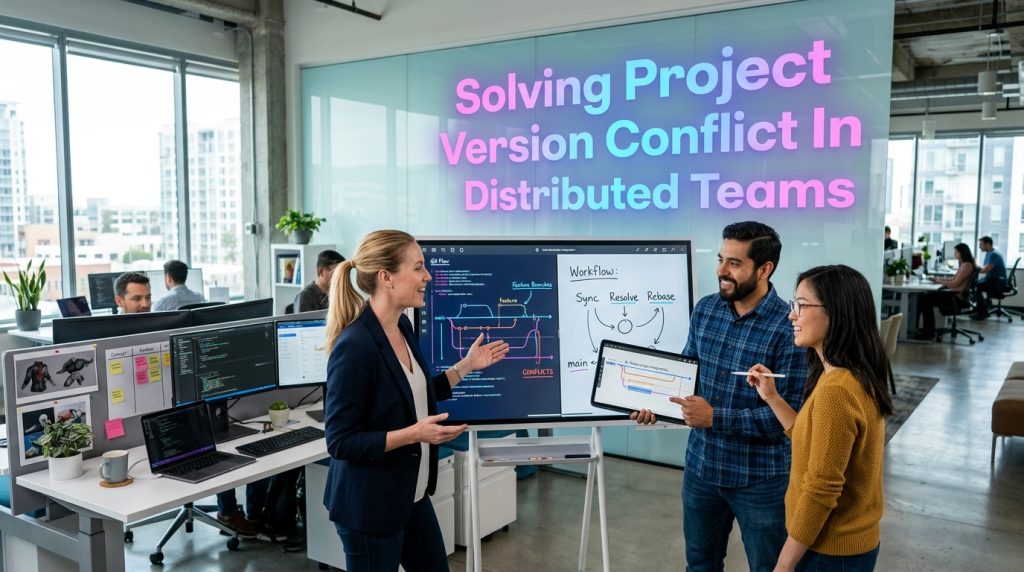
Solving Project Version Conflict In Distributed Teams
Version conflicts don’t just slow down your project, they can completely derail it. When teams spread across different time zones push competing changes to shared codebases, the resulting confusion can cost days of productivity and create lingering bugs that haunt projects for months.
Key Takeaways: Solving Project Version Conflict
- Resolving project version conflicts quickly can save distributed teams up to 20% of development time that would otherwise be lost to merge issues and rework.
- Implementing a clear branching strategy with defined workflows reduces conflict occurrence by over 70% in most distributed team environments.
- Communication protocols synchronized with your version control system are more effective than either approach alone.
- TeamCoherence’s conflict resolution toolkit helps teams establish automated guardrails that prevent common version control issues before they happen.
- The 3-step conflict resolution process outlined in this article can turn even complex merge scenarios into manageable, systematic solutions.
Understanding how to effectively resolve these conflicts is no longer optional for distributed teams—it’s a survival skill.
Project Version Conflicts That Destroy Team Progress
In my years working with distributed development teams, I’ve witnessed promising projects crumble under the weight of unresolved version conflicts. The typical scenario plays out predictably: two developers in different locations modify the same file simultaneously, both push their changes, and suddenly the project is in disarray with competing versions that seem impossible to reconcile. TeamCoherence research shows that unresolved version conflicts account for up to 30% of missed deadlines in distributed software projects.
How Conflicts Silently Kill Productivity
Version conflicts rarely announce themselves with flashing red lights. Instead, they lurk in the background, creating cascading issues that may not become apparent until days later. Developer A in New York pushes code at 5 PM, while Developer B in Singapore makes contradictory changes eight hours later. The system might accept both changes, but functionality breaks in subtle ways that only appear during integration testing. By then, both developers have moved on to new tasks, making the project version conflict resolution process exponentially more difficult and time-consuming.
The True Cost of Unresolved Version Issues
Beyond the immediate time lost to fixing conflicts, there are hidden costs that affect your entire project ecosystem. Team morale suffers when developers constantly battle merge issues instead of building new features. Customer satisfaction drops when releases are delayed due to integration problems. Perhaps most concerning is the technical debt that accumulates when conflicts are resolved hastily through quick fixes rather than proper reconciliation. One study found that teams spend an average of 15-20% of their development time dealing with version-related issues—time that could be spent delivering value.
The financial impact is equally significant. For a team of five developers with an average salary of $120,000, project version conflict resolution can cost upwards of $100,000 annually in direct labor. Add the opportunity cost of delayed releases and the picture becomes even more sobering.
Why Distributed Teams Face More Severe Conflicts
Distributed teams encounter version conflicts with greater frequency and complexity than co-located teams for several fundamental reasons. First, the communication barriers inherent in remote work mean that casual conversations about who’s working on what don’t happen naturally. Second, time zone differences create longer gaps between when conflicts occur and when they’re discovered, making them harder to reconstruct and resolve. Third, cultural and linguistic differences can lead to misinterpretations about branching strategies and merge protocols.
Without deliberate systems to counteract these challenges, distributed teams can find themselves in a perpetual cycle of conflict resolution rather than product development. The key is not just having version control—it’s having a version control strategy specifically designed for distributed work.
5 Common Project Version Conflicts in Remote Teams
Understanding the enemy is half the battle. After analyzing hundreds of version conflicts across dozens of distributed teams, I’ve identified five distinct patterns that consistently create the most disruption. Recognizing these patterns is the first step toward implementing effective prevention strategies.
1. Simultaneous File Editing Without Proper Branching
The most common project version conflict scenario occurs when multiple team members edit the same file concurrently without an adequate branching strategy. This typically happens with critical files that serve as integration points in the codebase. For instance, configuration files, central service components, or database schemas are prime targets for this type of conflict. When Developer A in Berlin modifies an authentication service while Developer B in Toronto simultaneously updates the same component, the resulting merge conflicts can be nightmarishly complex, especially if both made structural changes.
2. Incompatible Tool Versions Across Team Members
Version conflicts aren’t limited to code—they extend to the tools teams use to create that code. When different team members use different versions of the same development tools, subtle incompatibilities can introduce conflicts that are difficult to trace. I’ve seen entire sprints derailed when half the team upgraded to a new compiler version while others remained on the previous release.
- IDE version discrepancies causing formatting conflicts
- Compiler version differences generating incompatible binaries
- Package manager version inconsistencies leading to dependency conflicts
- Database migration tools creating schema version mismatches
- API client generators producing incompatible service interfaces
3. Merge Conflicts From Poor Communication
Communication breakdowns magnify version control problems exponentially. When team members don’t clearly communicate their intentions before making changes, they often end up working at cross-purposes. I recently consulted with a team where two developers spent three days refactoring the same module in completely different ways—neither aware of the other’s efforts. When they attempted to merge their changes, they faced hundreds of conflicts that could have been avoided with a simple conversation.
4. Timezone-Related Commit Overlaps
The global nature of distributed teams means work happens around the clock. This continuous development cycle creates a unique vulnerability: timezone-related commit overlaps. When Developer A in San Francisco commits changes before leaving work, and Developer B in Singapore pulls the repository first thing in their morning (but before A’s changes have been pushed), they’re working from different baselines. The result is often a “split-brain” scenario where parallel versions of the same code evolve independently, making eventual reconciliation extremely difficult.
5. Conflicting Project Dependencies
Modern software projects rely heavily on external dependencies and libraries. When different team members update these dependencies independently, version conflicts emerge that can be particularly insidious. These conflicts often don’t appear during local development but cause catastrophic failures during integration. I’ve witnessed builds failing mysteriously because one developer updated a critical library while another continued to use methods that were deprecated or removed in the newer version.
Set Up Your Version Control System For Distributed Success
A well-configured version control system acts as the foundation for conflict-free collaboration. Rather than treating your version control as a simple code repository, approach it as a communication tool that coordinates your distributed team’s efforts. The right setup can prevent conflicts before they happen and simplify resolution when they do occur.
Git-Based Workflows That Prevent Conflicts
Git has become the de facto standard for version control, but using it effectively requires adopting a workflow that matches your team’s distribution pattern. For highly distributed teams, I typically recommend a fork-based workflow with feature branches. This approach creates natural isolation between team members’ work while maintaining a clear path back to integration. Each developer maintains their own fork of the main repository, creates feature branches for specific work items, and submits pull requests when ready to integrate changes. This workflow dramatically reduces direct conflicts by creating explicit integration points where potential issues can be identified and resolved.
Branch Strategy For Multi-Location Teams
Your branching strategy should reflect the geographic distribution of your team. For instance, if you have distinct development centers in different regions, consider creating integration branches that align with these geographic divisions. This creates a hierarchical integration process where conflicts are resolved at progressively higher levels. Local teams can integrate frequently within their geographic unit, resolving simpler conflicts, before pushing to higher-level integration branches where cross-team conflicts are addressed. This approach contains conflict resolution within the most appropriate context, preventing simple conflicts from becoming project-wide issues.
A particularly effective pattern I’ve implemented with several multinational teams is the “follow-the-sun” branching strategy. Each regional team works on their own integration branch during their workday, then passes control to the next region at the end of their day. This creates a natural rhythm of development and integration that minimizes direct conflicts while maintaining rapid progress.
Code Review Protocols That Catch Conflicts Early
Code reviews aren’t just for quality assurance—they’re your first line of defense against version conflicts. Establish clear protocols that require reviewers to specifically check for potential integration issues. This means looking beyond the code itself to consider how changes might interact with work happening in parallel. Train reviewers to ask questions like “Who else might be modifying related components?” and “What dependencies might be affected by these changes?” Some teams I’ve worked with assign a specific “integration reviewer” role that rotates among team members, whose sole responsibility is to evaluate changes from a conflict-prevention perspective.
Automation Tools That Flag Potential Issues
Modern version control systems offer powerful automation capabilities that can help identify potential conflicts before they become problems. Set up pre-commit hooks that scan for overlapping work based on file modification patterns. Configure your CI pipeline to run merge simulations against in-progress branches to provide early warnings about potential conflicts. Tools like GitHub’s branch protection rules or GitLab’s merge request approvals can enforce policies that prevent problematic changes from entering your main branches.
For distributed teams, I strongly recommend implementing “change heatmaps” that visualize which parts of your codebase are undergoing frequent modification by multiple team members. These visualizations help identify hotspots where conflicts are likely to occur, allowing you to implement more stringent controls or better coordination for those specific areas.
Practical Prooject Version Conflict Resolution Techniques
Despite your best prevention efforts, conflicts will inevitably occur. When they do, having a systematic approach to resolution makes all the difference between a minor hiccup and a major project disruption. The techniques below have been battle-tested across dozens of distributed teams and consistently produce clean, reliable resolutions with minimal disruption to workflow.
The 3-Step Conflict Resolution Process
When faced with a merge conflict, follow this structured approach to ensure thorough resolution without introducing new problems. First, understand exactly what’s conflicting and why—identify the developers involved and the intent behind each conflicting change rather than just looking at the code differences. Second, communicate with all stakeholders before making resolution decisions, especially if the conflict spans team boundaries or time zones. Third, implement the resolution with comprehensive testing, ensuring that the merged code functions correctly in all scenarios that either original version handled. This methodical process prevents the common mistake of resolving conflicts syntactically while breaking functionality semantically.
Using Visual Diff Tools Effectively
Visual diff tools transform conflict resolution from a textual puzzle to a clear visual comparison, but their effectiveness depends on how you use them. Rather than accepting the default three-way merge view, customize your visualization to highlight semantic units like functions or classes rather than just lines of code. Advanced tools like Beyond Compare or KDiff3 allow you to synchronize scrolling between conflict sections, making it easier to understand the broader context of changes. When working with complex conflicts, use the “ignore whitespace” option to focus on substantive changes rather than formatting differences. For distributed teams, cloud-based visual diff tools like those integrated with GitHub or GitLab enable real-time collaborative conflict resolution, allowing developers across different locations to work together on particularly challenging merges.
When To Rebase vs. When To Merge
The eternal debate between rebasing and merging has practical implications for prooject version conflict resolution in distributed teams. Rebasing creates a cleaner, more linear history but rewrites commit history, which can complicate matters when multiple developers are involved. As a general rule, use rebase for local branches that haven’t been shared with the team, and merge for any branches that have been pushed to remote repositories. When conflicts involve significant architectural changes, consider a hybrid approach: have the developer with the smaller change rebase their work onto the larger change, then create a merge commit to preserve the historical record of the integration. This approach combines the clean history of rebasing with the transparent tracking of merges.
Handling Complex Merge Conflicts Without Panic
Complex merge conflicts can trigger anxiety even in experienced developers. When facing a particularly thorny conflict involving multiple files and interrelated changes, break it down systematically. Start by resolving the simplest conflicts first to build momentum and clarity. For complex files, consider resolving them in isolation through temporary branches to test each resolution independently before bringing them together. When dealing with particularly convoluted conflicts, don’t hesitate to pull in the original authors for a virtual pair programming session focused solely on resolution—the time investment pays off by preventing subtle bugs that might otherwise slip through.
Sometimes the best approach is to step back and reconsider the entire merge. I once worked with a team that spent days trying to resolve conflicts between two major refactoring efforts, only to realize that creating a fresh branch and manually applying the conceptual changes from both branches produced a cleaner result in less time than continuing to fight through automated merges.
Documentation Practices That Prevent Future Conflicts
Documentation isn’t just about explaining how code works—it’s about preventing conflicts before they happen. Implement architecture decision records (ADRs) that document major design decisions, making it clear which parts of the codebase are governed by which principles. Create and maintain ownership maps that identify which teams or individuals have primary responsibility for different components, providing natural points of contact when changes might overlap. Most importantly, document your merge project version conflict resolutions, explaining not just what you did but why you chose that approach. This creates an organizational learning process where the team gets progressively better at avoiding similar conflicts.
Team Communication Practices That Prevent Version Hell
While technical solutions are essential, the most effective conflict prevention happens through communication. In distributed teams, deliberate communication practices can compensate for the missing in-person interactions that naturally prevent conflicts in co-located teams.
Daily Sync Strategies For Different Time Zones
The traditional daily standup meeting breaks down when your team spans multiple time zones. Instead, implement asynchronous daily updates where each developer posts what they’re working on, which files they’ll likely modify, and any integration concerns they anticipate. Tools like Slack, Microsoft Teams, or dedicated standup tools like Standuply can facilitate this process. For teams with partial timezone overlap, consider a rolling standup where developers in transitional time zones participate in multiple brief syncs, creating a communication bridge between regions.
One effective approach I’ve implemented with global teams is the “handoff meeting” where developers ending their day meet briefly with those starting their day to discuss work in progress and potential conflict areas. This creates natural coordination points and ensures that knowledge transfers smoothly across time zones.
Project Management Tools Integration
Integrate your project management tools directly with your version control system to create visibility into who’s working on what. Configure your tools to automatically tag commits and branches with related ticket numbers, making it easy to see when multiple developers are addressing related areas. Set up notifications that alert developers when someone else begins work that might overlap with their current tasks. This integration creates a shared awareness that prevents many conflicts before they occur.
“We reduced merge conflicts by 63% in the first quarter after implementing automated work-in-progress notifications that alerted developers when multiple people were modifying the same module.” — Sarah Chen, Engineering Director at PaymentFlow
Clear Work Assignment To Minimize Overlap
The way you structure and assign work has a direct impact on project version conflict frequency. Design your tickets and tasks with clear boundaries that minimize file overlap between developers. When assigning work, consider component ownership and technical context to keep related changes together with the same developer or team. For areas that require frequent changes from multiple developers, consider implementing a “module guardian” role where one developer temporarily coordinates all changes to that area during periods of intensive development. For more insights on managing distributed teams, check out these tips for managing distributed project teams.
Advanced Conflict Prevention For Large-Scale Projects
As projects scale beyond a few dozen developers, especially in distributed environments, standard practices become insufficient. These advanced techniques become essential for managing version conflicts at scale.
Monorepo vs. Multiple Repositories
The choice between a monorepo (single repository containing all code) and multiple repositories significantly impacts your conflict patterns. Monorepos provide unified versioning and make cross-component changes more manageable but can increase the frequency of merge conflicts as more developers work in the same repository. Multiple repositories create natural boundaries that prevent many conflicts but can make cross-component changes more difficult to coordinate. For distributed teams, I often recommend a hybrid approach: use multiple repositories for clear component separation, but implement tools like Google’s Repo or Microsoft’s Git Virtual File System to provide monorepo-like workflows when needed.
Continuous Integration Configurations
Your CI pipeline is a powerful tool for detecting and preventing conflicts early. Configure pre-merge integration tests that simulate merging feature branches before the actual merge occurs, flagging potential conflicts before they impact the main branch. Implement “integration builds” that periodically combine all in-progress feature branches into a temporary integration branch to identify conflicts that might not be apparent when testing branches individually. For large teams, consider implementing a “merge train” approach where proposed changes queue up and are integrated in sequence, with each integration being fully tested before the next begins.
Automating Version Compatibility Checks
For projects with complex dependency structures, automated version compatibility checking becomes essential. Implement dependency analysis in your build process that verifies compatibility across all components. Use tools like Dependabot or Renovate to automate dependency updates across your repositories, ensuring consistency. For internally developed components, establish version contracts and automated compatibility tests that verify interactions between components at different version levels.
Feature Flagging To Reduce Merge Conflicts
Feature flags (also called feature toggles) allow incomplete or potentially conflicting code to coexist in the main branch without causing functional conflicts. By wrapping new or changed functionality in conditional flags, developers can merge code more frequently, reducing the window for conflicts to occur. This approach is particularly valuable for distributed teams because it decouples code integration from feature release, allowing developers to continuously integrate their work without waiting for features to be completely finished.
When implementing feature flags, establish clear naming conventions and lifecycle management to prevent flag proliferation. Each flag should have an explicit owner and planned removal date to prevent technical debt accumulation.
Real-World Version Control Success Stories
Abstract principles only get you so far—seeing how real companies solve version control challenges provides practical insights you can apply to your own team. These case studies highlight different approaches that have proven successful in managing version conflicts in distributed environments.
How Spotify Manages Version Control Across Global Teams
Spotify’s engineering organization spans multiple continents with development centers in Stockholm, New York, London, and Singapore. Their approach to version management centers on their famous “squad” model, where small, cross-functional teams own specific features or components end-to-end. Each squad maintains primary ownership of its codebase, reducing the likelihood of conflicting changes from different teams.
For components that require contributions from multiple squads, Spotify implements a “code host” role—a developer who temporarily coordinates all changes to that component during periods of active development. This role rotates among team members to prevent knowledge silos while providing a clear point of contact for integration questions.
Perhaps most interestingly, Spotify has implemented automated “change impact analysis” in their CI pipeline that predicts which tests might be affected by a given change, allowing more focused validation of potentially conflicting modifications. This approach has reduced their integration issues by over 40% while speeding up their build process.
| Spotify Practice | Conflict Reduction Impact | Implementation Complexity |
|---|---|---|
| Squad-based ownership | High (65%+ reduction) | Medium (requires organizational restructuring) |
| Code host role rotation | Medium (30-40% reduction) | Low (primarily process change) |
| Automated change impact analysis | Medium (40%+ reduction) | High (requires sophisticated CI tooling) |
The key insight from Spotify’s approach is that version conflict management begins with organizational design—how you structure teams and ownership has a direct impact on conflict patterns. By aligning team boundaries with codebase boundaries, they naturally reduce the cross-team coordination burden.
Microsoft’s Approach To Cross-Timezone Development
Microsoft faces perhaps the ultimate version control challenge with Windows development, which involves thousands of engineers across multiple continents contributing to a codebase with millions of lines of code. Their approach centers on sophisticated branching strategies combined with rigorous automated validation. Development occurs in feature branches that must pass increasingly stringent integration tests before being merged into main integration branches.
What sets Microsoft’s approach apart is their investment in custom tooling that provides visualization of branch relationships and potential conflict areas. Their internal tools show developers a real-time “heat map” of the codebase, highlighting areas with high modification frequency that are likely conflict points. This visibility allows developers to make informed decisions about when to pull the latest changes and which areas require extra coordination.
Lessons From Open Source Project Management
Open source projects like Linux, Kubernetes, and TensorFlow deal with contributions from hundreds or thousands of developers with no organizational hierarchy to enforce coordination. Their success offers valuable lessons for distributed commercial teams. These projects typically implement a combination of clear ownership through maintainer roles, extensive automated testing that catches integration issues early, and explicit contribution guidelines that reduce the likelihood of conflicting changes. The pull request model pioneered in open source, where changes are proposed, reviewed, and integrated through a standardized process, provides natural checkpoints where conflicts can be identified and resolved before they impact the main codebase.
Team Culture That Supports Clean Version Control
Technical solutions alone can’t solve version control conflicts—you need a team culture that values clean integration and collaborative problem-solving. Creating this culture requires deliberate practices that reinforce good habits and create shared ownership of code quality.
Training New Team Members On Version Protocols
Don’t assume that new team members, even experienced developers, understand your specific version control workflows. Create onboarding materials that explicitly cover your branching strategy, merge protocols, and conflict resolution approaches. Assign version control mentors who review new team members’ first few pull requests with special attention to integration aspects. Consider implementing a “version control certification” process where new team members demonstrate understanding of your workflow before being granted full commit privileges.
Creating Accountability Without Blame
Version conflicts are inevitable, but how your team responds to them shapes your culture. Implement blameless post-mortems for significant project version conflict incidents, focusing on process improvements rather than individual mistakes. Track and visualize conflict metrics at the team level rather than the individual level to emphasize shared responsibility. Recognize and celebrate proactive conflict prevention, such as when team members coordinate effectively on potentially overlapping changes.
Celebrating Conflict Resolution Success
Positive reinforcement shapes culture more effectively than negative consequences. Create recognition for team members who effectively resolve complex conflicts or implement systems that prevent conflicts. Share success stories in team meetings, highlighting specific techniques that worked well. Consider implementing “integration hero” recognition for team members who go above and beyond in helping resolve particularly challenging merges.
Project Version Conflict Action Plan
Transforming your team’s approach to version conflicts doesn’t happen overnight. Implement this progressive action plan to systematically reduce conflicts and build a sustainable integration practice. Start with a conflict audit to identify your most common patterns, then implement technical safeguards that address those specific patterns. Next, establish communication protocols that create visibility into potentially conflicting work. Finally, build team skills through targeted training on conflict prevention and resolution techniques.
Remember that consistency matters more than perfection. It’s better to fully implement a simple branching strategy that everyone follows than to design an elaborate system that’s inconsistently applied. Measure your progress not just by counting conflicts but by tracking the time spent resolving them and the impact they have on your delivery schedule. With persistent focus and continuous improvement, even the most distributed team can achieve smooth, predictable integration.
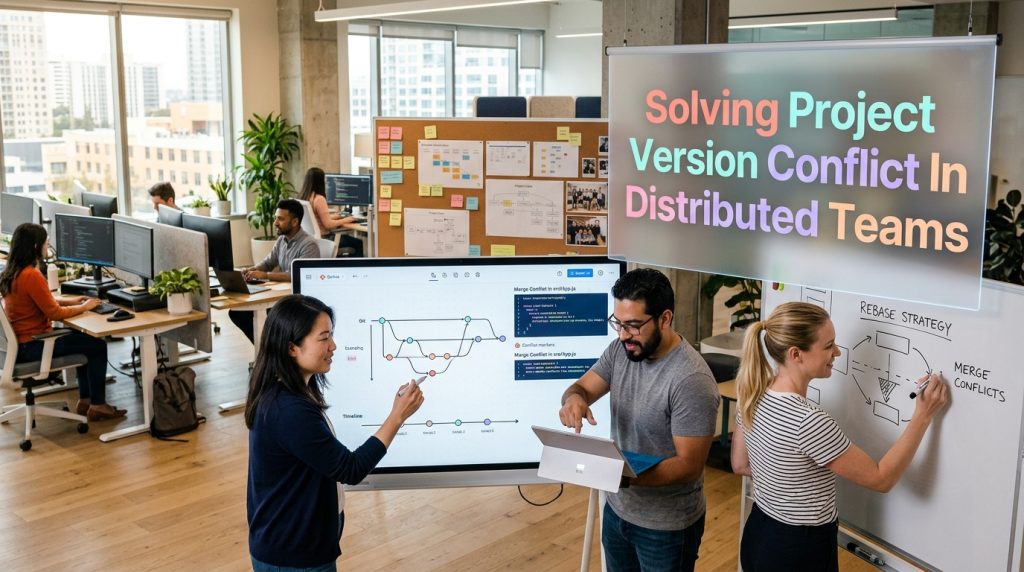
FAQ’s About Solving Project Version Conflict In Distributed Teams
Over years of consulting with distributed teams on version control challenges, certain questions consistently arise. Here are practical answers to the most common concerns teams face when dealing with project version conflicts.
How often should distributed teams push their code changes?
The optimal frequency for pushing code changes depends on your team’s distribution pattern and the nature of your codebase. As a general rule, developers should push completed logical units of work at least once per day, even if the feature isn’t complete. This reduces the window for conflicts to develop while ensuring that all code is backed up. For teams with significant timezone overlap, pushing at the end of each developer’s workday creates a natural rhythm where changes become visible to other team members in time for their workday.
More important than the frequency, however, is the predictability. Establish clear expectations about when code should be pushed and pulled, and ensure all team members adhere to these guidelines. Some teams implement “pull hours” at the beginning of each regional workday when everyone updates their local repositories, creating a consistent baseline.
What’s the best Git workflow for teams across multiple time zones?
For teams spanning multiple time zones, a feature branch workflow with pull/merge requests provides the best balance of independence and coordination. This approach allows developers to work autonomously within their feature branches while creating explicit integration points through the pull request process. Combine this with a “branch per ticket” approach to minimize the scope of each integration and reduce conflict likelihood. For very large teams, consider a hierarchical branching strategy where changes are first integrated at the regional level before being merged into the main branch.
Can version conflicts be completely eliminated in distributed teams?
Complete elimination of version conflicts is neither possible nor desirable in active development environments. Conflicts are a natural consequence of parallel work and often indicate healthy collaboration on important parts of the codebase. The goal isn’t to eliminate conflicts entirely but to make them predictable, manageable, and quick to resolve. Well-designed systems might reduce severe conflicts by 80-90%, but attempting to eliminate the remaining conflicts would likely impose coordination overhead that outweighs the benefits.
Should project managers be involved in resolving version conflicts?
Project managers shouldn’t directly resolve technical conflicts, but they play a crucial role in the conflict management process. Their primary responsibilities include facilitating communication between team members when conflicts span ownership boundaries, adjusting priorities when significant conflicts require focused resolution time, and tracking conflict patterns to identify potential process improvements. Project managers should also ensure that conflict resolution time is explicitly accounted for in sprint planning and project timelines, rather than treating it as invisible work.
For significant architectural conflicts that represent fundamental design disagreements rather than simple code conflicts, project managers should ensure that the right stakeholders are involved in the resolution decision and that the outcome is clearly communicated to the entire team.
What tools help visualize version conflicts for easier resolution?
Beyond basic diff tools, several specialized tools can transform how your team understands and resolves conflicts. Git-based visualization tools like GitKraken or Sourcetree provide intuitive graphical interfaces for understanding branch relationships and merge histories. For complex projects, dedicated merge tools like Beyond Compare or KDiff3 offer sophisticated three-way merge capabilities with customizable resolution rules.
For teams working at scale, consider specialized solutions like Plastic SCM’s semantic merge, which understands code structure beyond simple text differences, or Microsoft’s Git Virtual File System (GVFS) for handling extremely large repositories. Cloud-based code review platforms like Gerrit or ReviewBoard can also integrate conflict detection directly into the review process, flagging potential issues before merge attempts.
When your team is spread across time zones, version conflicts can stall progress, but our synchronization protocols bridge the distance seamlessly.
We provide the collaborative rulebooks and conflict-resolution workflows that keep remote teams operating in perfect harmony.
Visit https://bestprojectkits.com to equip your distributed workforce with the tools they need to collaborate without collision.
===========================================================================
ABOUT THE AUTHOR
Gerard Mohamed is a project management expert with over 30 years of hands-on experience managing high-stakes projects in the petrochemical and marine engineering sectors.
He holds an MBA from Business School Netherlands and a BCom (Hons) with dual majors in Project Management and Advanced Marketing. As a qualified Marine Engineer, Gerard serves as Chairman of the Cape Branch of the South African Institute of Marine Engineers and Naval Architects (SAIMENA) and sits on their National Executive Committee.
Gerard is a fully accredited Facilitator and Assessor for Project Management under South Africa’s SETA and QCTO, and teaches Project Management part-time at two leading business colleges.
After decades of struggling to find practical, field-tested project templates, he created BestProjectKits.com — a comprehensive library of 3,500+ professionally designed templates that solve real-world project challenges across 20+ industries.
→ Explore the complete template library at BestProjectKits.com
→ Connect with Gerard: [admin@bestprojectkits.com]
=========================================================================